
Office Building Roofing in Tuscaloosa, AL
Up on an office building, a superintendent usually finds a low-slope membrane, often a white single-ply or a modified bitumen sheet, bounded by a parapet and crowded with rooftop units whose condensate lines, refrigerant lines and curbs have been added and altered over many tenant cycles. The roof is quiet most days, and the ceiling below is where it announces itself. We repair, recover and replace office roofs in Tuscaloosa, AL, and our reports show an asset manager which roof sections protect which suites and what each will cost to leave alone another year.
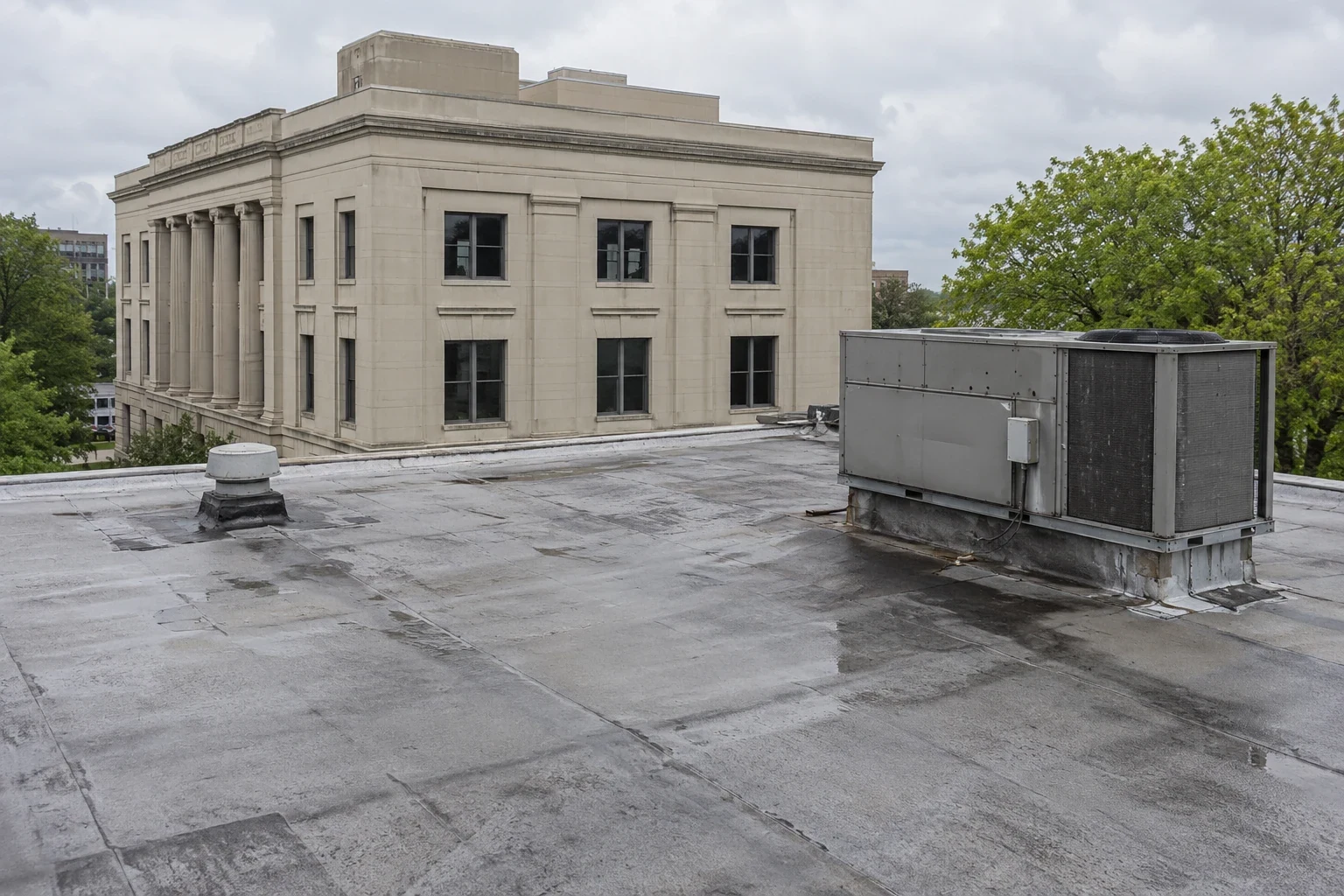
Rooftop Units, Parapets and Tenant Changes
Office roofs carry package units, split-system condensers, exhaust fans and sometimes a cooling tower, and the count changes as tenants come and go. Each change can leave an orphan curb, a capped line or a patched penetration. We compare the roof with the last drawing, mark each item that has no function and recommend removing or sealing it properly, because abandoned equipment curbs are quiet leak sources.
Parapets and walls add detail work. Where a membrane meets a parapet, the base flashing, counterflashing and cap carry the load of weather on the wall above, and a hairline gap in any of them lets water behind the wall finish. We examine each, tap the cap for loose joints and check that scuppers through the parapet are properly lined and not choked.
Office buildings in the Midtown 15th Street area and along other main roads share these conditions with buildings anywhere. What changes from one to the next is the number of tenants, which sets how many people call about a stain and how many schedules the work must respect. We note the tenant mix on the roof plan so a leak can be traced to the suite and the responsible party quickly.
Condensate, Service Traffic and Drains
Two things wear office roofs faster than weather alone: condensate and service traffic. Condensate discharged onto the membrane stains it, feeds algae and, where it freezes or stands, adds load to a low area. Technicians who step off a path onto the sheet scuff and puncture it. We look for both, recommend pads and drip pans, and add a walkway where a worn route shows.
Drains in an office roof are often few, so each one carries a larger share of the roof. We clear sumps, check strainers and measure how long water stands after rain. A roof that holds water more than a day is flagged for tapered insulation or an added drain, and our roof drain and scupper work restores the flow before the next storm cycle.
Interior evidence helps the roof survey. Ceiling stains that return after repairs, tiles that sag only after storms, musty odor near an exterior wall and condensation at a diffuser each point to a different cause. We ask the property manager for the maintenance log and compare complaint locations with the roof plan; a cluster under one curb or one drain tells us where to start and often saves hours of searching.
A core cut at a stained location shows whether the insulation is wet and how far it extends. The moisture reading goes in the report with the core photograph, and the decision between patch, partial replacement and full tear-off follows from the measured boundary rather than from the visible stain.
Wind History Along the City's Main Corridors
Tuscaloosa's office buildings stand along roads such as University Boulevard, which is State Route 215, and McFarland Boulevard, which is US 82. Both the 2011 tornado, an EF4 that crossed 15th Street and McFarland Boulevard, and the straight-line wind of May 2025 north of Northport, surveyed at 90 to 100 mph, tested buildings like these. Parapet caps, edge metal and rooftop equipment tie-downs are the first things wind tests.
We check cap joints, edge fasteners and unit fastening and record the wind-uplift rating for each roof section. After a storm, the baseline lets us show an insurer what changed. A wind damage roof repair then proceeds from documented conditions rather than from memory.
Heat Load and Rainfall on a Flat Roof
Rainfall of about 53.5 inches and a record high of 107 F frame the year. A membrane that bakes in July and takes heavy rain in spring ages at the seams, around curbs and wherever the sheet is fastened. A reflective surface reduces the heat, and a roof that sheds water quickly reduces the time moisture can work at the details.
Where an office roof is nearing replacement, we compare options such as TPO roofing, PVC and modified bitumen against the building's equipment, foot traffic and drainage. Insulation upgrades may be needed to meet current energy requirements, and the scope version states them separately so the owner sees the choice.
Phasing Around Tenants
Tenants notice noise, dust and odor, so office reroofing is sequenced around them. We confirm suite hours, locate air intakes, schedule the loudest tear-off in agreed windows and protect interiors below any opening. Parking, deliveries and entrances are kept clear. For multi-tenant buildings, a single point of contact for the property manager keeps notices and complaints in one place.
The building department confirms insulation and wind requirements before pricing. The method for reroofing an occupied building applies, down to the punch list and warranty walk at the end, with a little less sensitivity than a medical office where interior risk is higher.
Weather planning matters on a flat roof in a humid climate. Summer thunderstorms build quickly, so the crew checks the forecast each morning, sizes the day's section to what can be closed before the afternoon and keeps temporary protection staged at the edge of the open area.
What to Carry on the Books
For an office asset, the roof is a line in the capital plan with a range for its remaining life. We provide a rating per section, a list of repairs that would extend service and the equipment and suites below each section. Property managers who hold several buildings can use roof capital planning to rank them, and the record helps in lease negotiations, since a documented roof is easier to price into operating expenses.
The file should also state the inspection interval and what would move it: a storm, an equipment change or a repeat leak. Written down, those triggers keep the roof from drifting off the agenda until a ceiling tile drops.
Where the building is part of a portfolio, it is ranked against the government buildings and hotels alongside it, since consequence and tenant sensitivity change the order and help an asset manager defend one roof ahead of another.
Commercial Roofing Questions
What is an orphan curb and why does it matter?
It is a curb left after equipment was removed. If it is not capped and flashed, it leaks. We recommend removal or proper sealing.
Can an office stay open during a roof replacement?
Yes. We plan noise windows, protect interiors and keep entrances and parking clear.
How do I know if a parapet cap is failing?
Look for open joints, stains on the wall below and loose sections when tapped. We check each and recommend repair or replacement.
Does a white roof reduce cooling cost?
It lowers surface heat, which can reduce load on the units below. The effect depends on insulation, orientation and equipment, and we discuss it with the owner.
What decides the inspection interval?
Roof condition and consequence. A roof with repeat repairs earns a shorter interval, and a clean roof can go longer.