
Roofing for School Districts in Tuscaloosa, AL
A school campus is a collection of roofs built in different decades by different contractors, and the superintendent who walks one finds the pattern at once: a flat roof over a classroom wing, a membrane or metal roof over the gymnasium, a newer addition on a different system and a flat canopy over the bus loop that nobody has looked at since it was built. Each section has its own age and leak history, and the facilities director has to rank them for a board that meets once a month. Rain at 53.5 inches a year and a history of severe wind fall on those roofs in Tuscaloosa, AL, so repair and replacement have to be scheduled around the weather and the calendar together.
The summer window and the school year
A district's roofing calendar is mostly the summer break. From the last day of classes to the first day of the fall term, a campus is empty, and that stretch is when large replacements happen. The window is short, the weather is hot and storms still arrive, so planning has to start the winter before. Material lead times, bid schedules and board approvals all come first, and a roof that is not funded by spring is not replaced that summer.
During the school year, the work shifts to repairs and inspections. Leaks over classrooms are tracked and mapped, temporary covers are placed, and permanent work is scheduled for the next break. We work with the facilities director to sort every leak into one of three groups: stop it now, stage it for a holiday break or hold it for the summer replacement.
Student safety, access and the work zone
On an occupied campus, the work zone is fenced and signed, the lift and the dumpster stay out of drop-off lanes and bus loops, and the crew does not use areas where students walk. Deliveries come outside arrival and dismissal times. Noise and fumes are managed near classrooms, and air intakes are located and protected. Hot work follows a fire watch, and the roof is cleaned of fasteners and debris at the end of every shift, since a stray screw in a playground is a student injury. A magnetic sweep of the ground around the work zone is part of the closeout each evening, and the foreman signs the sweep log for the principal or the facilities lead.
When a summer job runs into the first days of school, the crew finishes the sections over occupied rooms first and leaves the unoccupied wings for the weekend, so classes open on a dry building.
Bids, specifications and board approval
Public school work goes out to bid, and a clear scope produces cleaner bids. We help the district write the scope from the walk: roof sections, quantities, deck repair allowances, insulation thickness, flashing details and warranty requirements. With unit prices set for wet insulation and deck repair, the board compares bids on equal terms and has fewer change-order disputes once work starts.
Our roof condition reports are written to be attached to a board packet. Each campus gets a page, each roof section gets a rank and a cost to leave it alone, and the whole list can be read in a short meeting. Related public owners, such as cities and agencies, use the same format.
Gyms, cafeterias and the roofs with special jobs
Some school roofs carry more than weather. A gymnasium has a long clear span and a floor that a single storm can ruin, a cafeteria and kitchen send grease-laden exhaust through the roof, and a boiler or chiller room may have curbs and penetrations that nobody has reviewed since they were added. We inspect those sections first, check the kitchen exhaust curb and the grease containment, and look at the gym roof from above and from below for stain lines along the framing. A leak over a gym floor gets a temporary cover the same day, and the permanent scope is written with the school's calendar in mind.
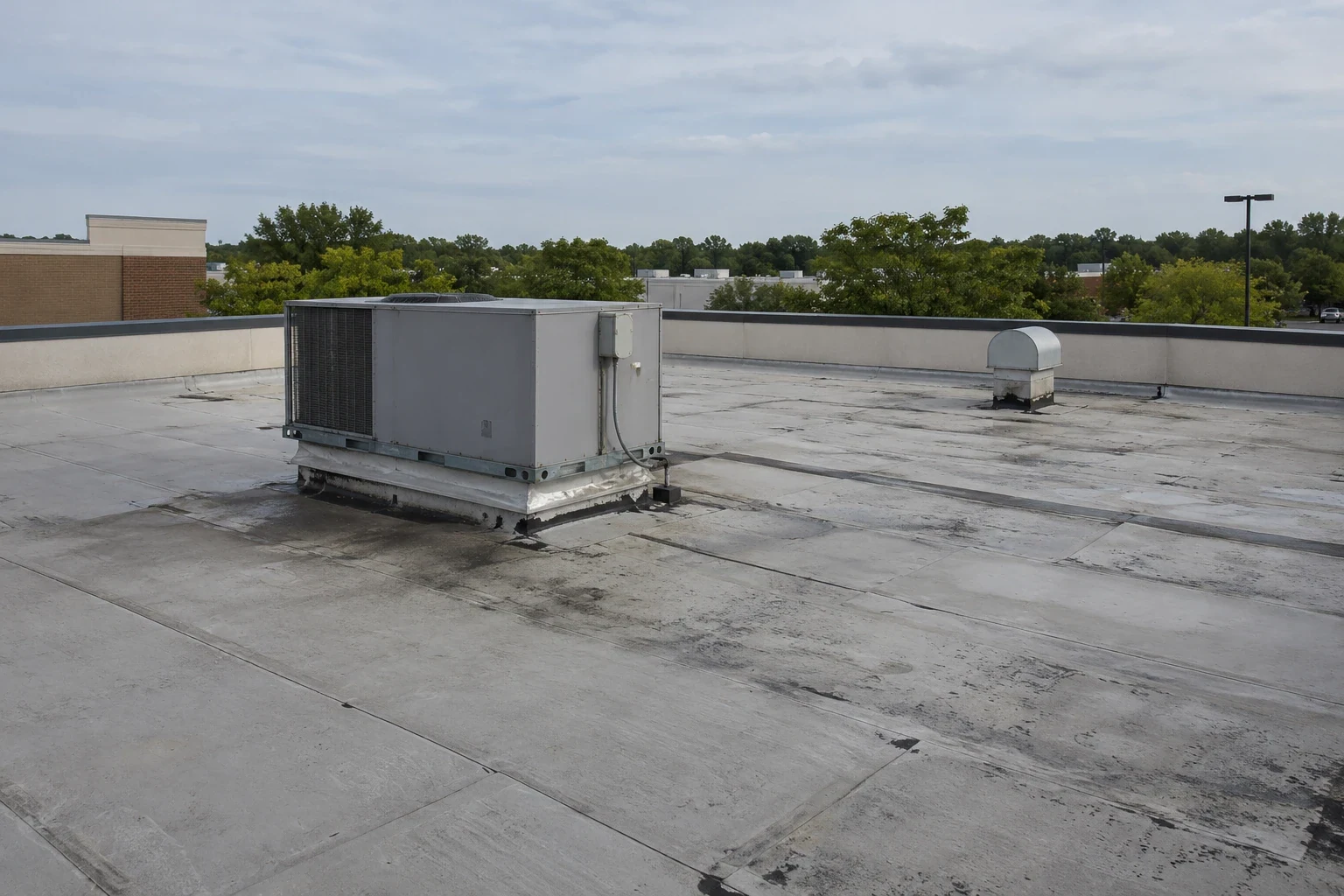
Roof-mounted equipment is a second thread. Each cooling or ventilation unit a district adds needs its own curb, flashed into the membrane, and the roofer should review the plan before the mechanical contractor opens the deck. We ask the facilities office to include roofing in the equipment project, and we review curb heights, support rails and walk pads so that the new unit does not become the next leak. Districts that also run construction programs with general contractors can fold that review into the contractor's schedule.
Older buildings, layers and hidden conditions
Older school roofs can hide surprises. Multiple layers of roofing, wet insulation, deteriorated decking and, on very old buildings, roofing materials that must be tested for hazardous content before they are disturbed, all affect the scope. We cut cores to read the layers, take moisture readings and recommend testing where the age of the building calls for it, so the district knows the conditions before bid day and not after tear-off. Allowances for deck repair and wet insulation are written as unit prices, with an expected quantity from the cores, so a surprise on the roof becomes a known line on the contract. Where a roof is dry and the deck is sound, a recover may avoid tear-off. Where the insulation is wet, tear-off is the right scope.
Wind, rain and heat across a campus
Cedar Crest and Alberta City were both damaged by the 2011 EF4 after it passed 15th Street and McFarland Boulevard, and in May 2025 the straight-line storm that hit north of Northport ran 90 to 100 mph. Every school roof gets its wind-uplift rating, edge metal and attachment checked, with a pull test where the original rating is lost. Since highs have reached 107 F, summer reroofing starts at dawn, and drains, scuppers and gutters are cleared before the wet season so the first big storm does not find a clogged outlet. The 2021 International Building Code governs the design of a replacement.
What to carry on the books
A district's roof register lists each campus, each roof section, the system, the age, the last report, the warranty and the reserve. A roof capital plan turns it into a multi-year sequence, and a preventive maintenance program keeps drains and seams on a schedule between replacements. The format fits school buildings of every size, from a single-story elementary building to a multi-wing high school, because each roof section is ranked by what is under it and not by the grade level it serves, and it works the same way for buildings in Alberta City or Northport.
Principals and custodial staff usually see leaks first, so the report gives each campus a one-page contact sheet for roof problems, with the order in which to cover equipment, move supplies and call for help.
Commercial Roofing Questions
How early should a summer reroof be planned?
The winter before. Bids, board approval and material lead times take months, and the summer window is short.
What happens to leaks during the school year?
They are mapped, covered and ranked. Permanent repairs go to the next holiday break or the summer, depending on severity.
Do older roofs need testing before tear-off?
Often, on very old buildings. We read the layers, cut cores and recommend testing where the age calls for it.
How is student safety handled during roof work?
With fencing, separate delivery times, protected air intakes, a fire watch for hot work and daily cleanup of the roof and ground.
Can one report cover many campuses?
Yes. Each campus gets a page, each roof section a rank, and the whole list reads in one board meeting.