
Preventive Roof Maintenance in Tuscaloosa, AL
Walking a McFarland Boulevard retail center roof, a superintendent usually finds the same short list of neglected items before anything is actually broken: a drain sump half full of leaves and grit, a pitch pan around a gas line that has pulled away from its pipe, a sealant bead at the coping that has cracked open, and a row of footprints leading to a rooftop unit where nobody laid a walk pad. None of those is a roof failure yet. All of them are the way a roof failure starts, and they cost almost nothing to correct while they are still small.
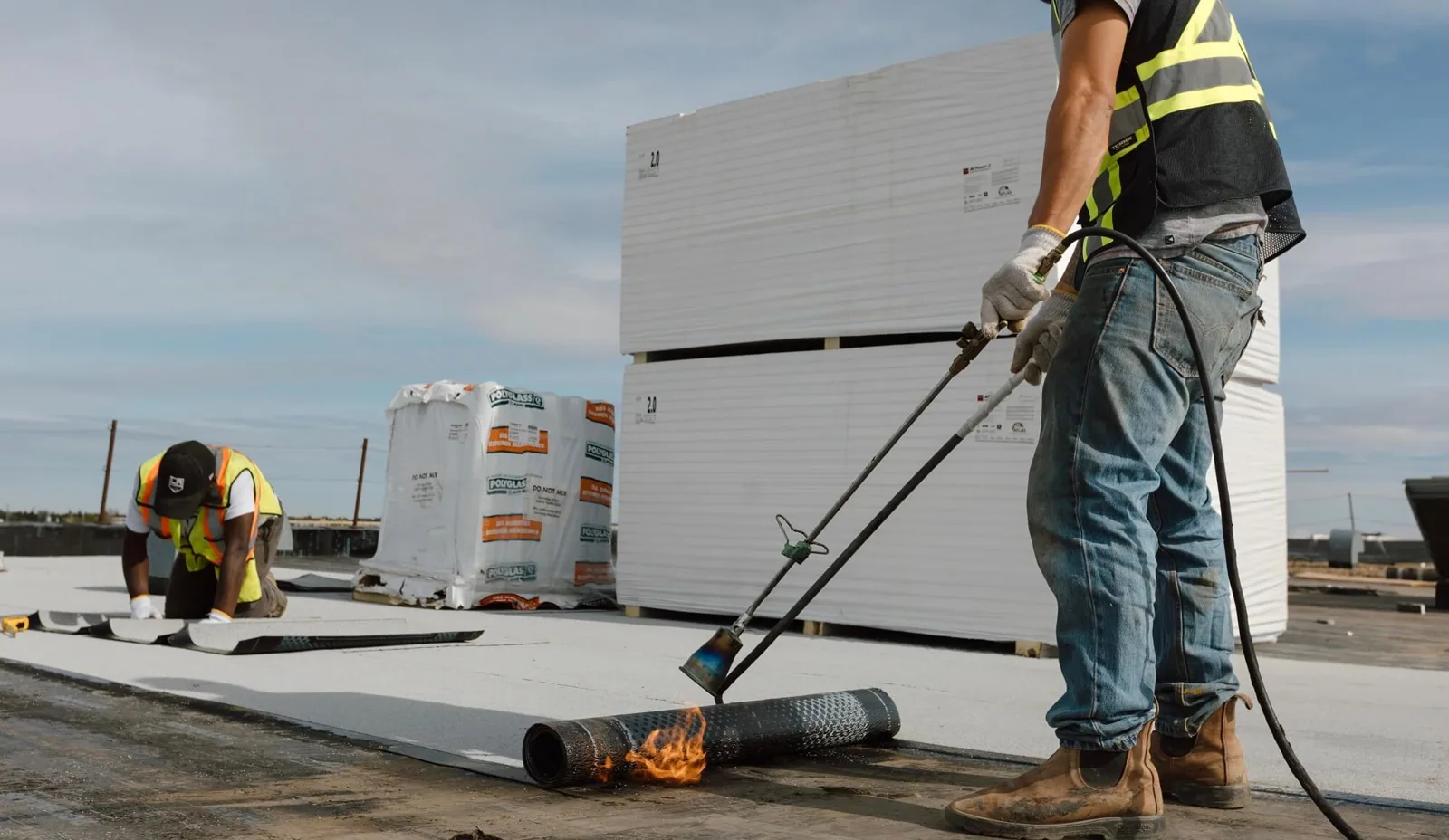
A maintenance program is the discipline of finding those items on a schedule, correcting them in the same visit where possible, and writing down what the roof looked like so the asset manager has a record to carry forward. It is the least expensive roofing work an owner can buy.
What a Maintenance Visit Covers
Each visit follows the same route so the record compares from one season to the next. We start at the access point and the drains, move around the perimeter and parapet walls, cross the field of the roof, and finish at every penetration and each piece of rooftop equipment. Debris comes off the roof, drain baskets are cleared, and clogged scuppers are opened before anything else is touched. A drain and scupper repair follows when a sump has failed, not just clogged.
- Drain sumps, strainers, scuppers and overflow openings
- Membrane seams, laps, blisters and patches from earlier work
- Coping, edge metal, counterflashing and sealant joints
- Penetration flashing, pitch pans and rooftop unit curbs
- Walk paths, cable runs and equipment laid directly on the roof
Small defects are repaired on the spot with materials that match the system, because a mismatched sealant or an incompatible mastic creates a second problem next to the first. Larger work goes into a written list with a photo, a location on the roof plan and a recommended action, and it waits for the owner's approval before a crew mobilizes.
What We Find Between Storms
Rain totals near 53.5 inches a year here and the thermometer has touched 107 F, and the damage that weather does to a roof is mostly slow. Water stands near a drain until the membrane around it softens and the first seam opens. Heat moves a rooftop unit curb a little every afternoon, and the flashing around it fatigues. Leaves and seed pods from nearby trees settle exactly where water needs to leave, and a drain that was clear in March can be choked by May.
The visit also catches wear that has nothing to do with weather. Foot traffic to a rooftop unit scuffs a membrane down to its reinforcement in a few seasons, and ponding after a rain that passed days ago says the slope or the drain needs correcting. We also find damage that did not come from weather at all: a service technician's dropped tool, a satellite dish bolted through the membrane, a conduit run laid across the field without a support. Those show up quickly on a scheduled visit and are expensive when found late. A commercial roof inspection is the baseline, and the maintenance program carries it forward season after season.
Programs by Building Type
A warehouse in an industrial park such as the Tuscaloosa County Airport Industrial Park often has a large field, few penetrations and long runs of seam, so the program concentrates on drains, edge metal and the wall transitions at the dock side. A supplier plant in Cedar Cove Technology Park has process exhaust, rooftop makeup air and a heavy mechanical load, so the program adds frequent looks at curbs and the membrane around fans.
Retail centers along University Boulevard and Skyland Boulevard commonly carry restaurant exhaust, signage supports and several tenants' rooftop units on one roof, which makes walk paths and penetration records the main items. Hospitals and medical offices, where Northport Medical Center is among the larger employers, add infection-control rules for roof access. We set the visit frequency by building type and by what sits under each roof section, not by a calendar that treats every building alike. A roof over a records room or a production line gets a shorter interval than a roof over a storage bay, and the program says so in writing.
Edge Metal and Wind Readiness
Tuscaloosa's roof history is a wind history. In April 2011 an EF4 tornado, estimated at 190 mph, took out warehouses in the 35th Street industrial area before it crossed 15th Street and McFarland Boulevard. More recently, straight-line winds of 90 to 100 mph cut a swath nearly four miles wide west of US 43 north of Northport, per the National Weather Service survey of May 2025.
A maintenance program cannot turn a roof into a storm shelter. What it does is keep the edges in working order: coping that is fastened, edge metal with continuous cleats, sealant joints that are not open, and fasteners that still hold. Those are the details that decide how a roof behaves in a strong gust. Where an edge metal and coping repair is due, the visit identifies it before the next storm season, not after.
The Record an Asset Manager Keeps
Every visit ends with a short written summary: what was cleared, what was repaired, what is recommended and by when. Photos are filed by roof section, and repairs are logged against the roof plan so the history survives a change of property manager. When a roof comes up for a warranty walk, a lender review or a sale, that record shows what has been done and keeps owners from paying for work that was already completed.
The record also supports budget decisions. A section that needs repeated repairs at the same detail is a candidate for a larger fix; a section that is clean for several visits can stay on its current schedule. A roof capital plan built from these records replaces guesses about remaining life with notes from the roof itself. The format is the same for a center on McFarland Boulevard as for a plant across the city.
Commercial Roofing Questions
How often should a maintenance visit happen?
Twice a year is common: once before the spring storm season and once after leaf fall. Buildings with heavy equipment, trees nearby or ponding history may need a third visit. We set the schedule by the roof.
Are small repairs included in the visit?
Yes, minor items such as drain clearing, sealant touch-up and loose fastener tightening are done during the visit. Larger repairs are listed with a recommended action and priced separately.
Does maintenance affect the manufacturer warranty?
Most warranties expect the owner to keep the roof clean and repair damage promptly. A written visit record helps show that. The warranty terms belong to the manufacturer, so confirm them with the paperwork.
Can maintenance extend a roof that is already old?
It can slow decline and catch leaks early, but it cannot restore a membrane that has reached the end of its life. The record tells you when repair stops paying.
What does the report look like?
A short summary, photos by roof section, a list of repairs made and a ranked list of items still open. It is built for an asset manager to file, share with ownership and compare next season.