
KEE Roofing in Tuscaloosa, AL
A KEE membrane is what a superintendent expects to find under a plant exhaust stack where oils and hot air have already eaten through a lesser sheet, and the walk starts there: at the stack, the fan curb and the drain below them, where the chemistry of the building shows up on the roof. Our crews install, repair and replace KEE membranes on commercial buildings in Tuscaloosa, AL, and each walk ends in a list of roof sections ranked by condition, so the asset manager knows which areas carry exposure and which can wait.
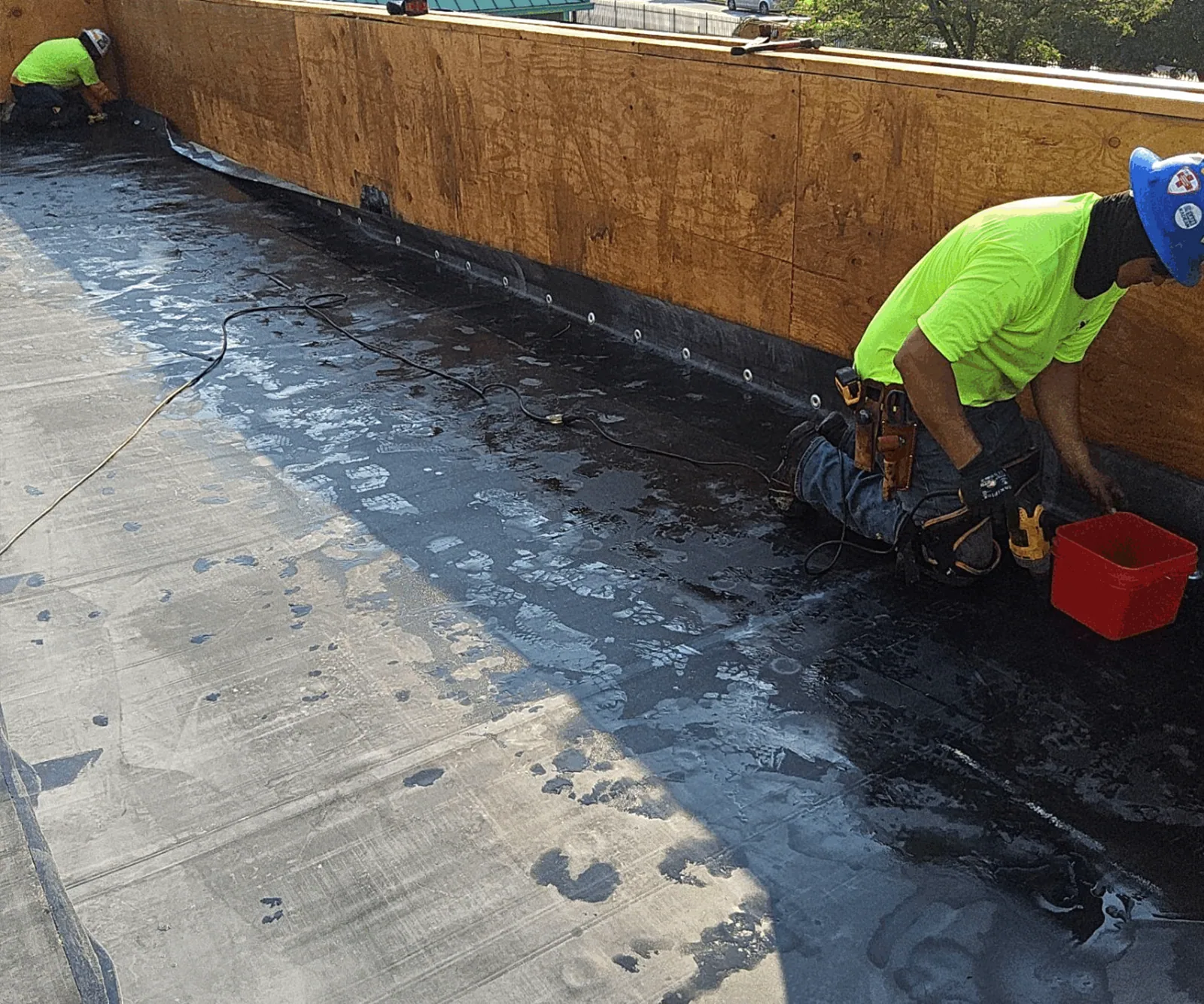
A PVC-Alloy Sheet Built for Oils
KEE stands for ketone ethylene ester, a polymer used in PVC-based roofing sheets to resist the plasticizer loss that makes ordinary PVC stiff. The result is a membrane that tolerates animal fats, vegetable oils and many industrial chemicals better than conventional single-ply sheets. Like PVC, it is reinforced with scrim and its seams are welded with hot air, so the laps fuse into the field.
It is installed over insulation and cover board, fastened or adhered, and flashed with formed pieces welded in place. Because the sheet is chosen for exposure, the layout of the roof matters as much as the material: where exhaust discharges, where runoff collects and where technicians walk. Walkway pads are heat-welded to the surface so that service traffic wears the pad and not the sheet, and they are replaced when they curl or lose their bond.
Wear Near Stacks, Fans and Drains
On a used KEE roof we check welds along every seam, flashing corners at curbs, surface staining around exhaust and the condition of walkway pads. We look for places where chemicals pooled in a low spot and where grease clogged a drain strainer. If a core cut shows wet insulation, we map the area and decide whether the damage is a local flashing failure or a wider water path.
We also look at what other trades have done: a cut for a new duct that was patched with sealant instead of welded flashing, a conduit run that rubs on the sheet, a unit set without a protection pad. Those are often the real cause of a leak on an otherwise sound roof. A roof walk with the plant's maintenance lead helps, because that person knows which unit was changed, which line was added and which corner has leaked every spring. We also pull a sample of the surface near each outlet when the owner allows it, since a lab look at the sheet can show whether chemical exposure has begun to change it before the surface shows damage. Where that is not possible, the touch and probe test goes in the report with a photo of each outlet.
KEE on Plants and Process Buildings
Tuscaloosa County has a heavy industrial base. Hunt Refining operates a petroleum refinery in Tuscaloosa that processes 52,000 barrels per day, Nucor Tuscaloosa makes coil and cut plate steel, and employers such as Michelin/BF Goodrich, Phifer and SMP Automotive each count over a thousand workers. Mercedes-Benz U.S. International sits on 1,000 acres near Vance, about 19 miles east of downtown Tuscaloosa. Industrial processes of this kind can put oils, solvents and hot exhaust on a roof, though what any one building discharges is a field question.
We record what the building does under the roof, and then we pick the system. Where a roof sees chemical exposure, KEE is one of the options we compare, along with PVC and a protected multi-ply system. The decision turns on what actually lands on the sheet, how often, and how hot it is when it arrives. A sample of the residue and a look at the exhaust schedule from the plant's maintenance staff usually settle it.
Edges, Terminations and Storm Records
Chemical resistance does nothing for a membrane that has lifted at the edge. The 2011 tornado, an EF4 estimated at 190 mph, tore through the 35th Street industrial area and destroyed warehouses, and survey crews put the straight-line winds north of Northport in May 2025 at 90 to 100 mph. On an industrial roof, that history is why perimeter attachment, edge metal and wind-uplift rating go on the report for every section.
We check the termination bars, the sealant at the top of flashings and the perimeter fastening, and we pull fasteners where the deck permits. Roof edges on process buildings also see steam from vents, ladders leaned against the parapet and equipment staged near the edge, so we look for crushed coping and dented flashing that the inspection report should tie to a cause.
Runoff, Ponding and Heat Load
Rain near 53.5 inches a year and heat up to 107 F set the normal stress on a KEE roof: a sheet that moves and water that has to leave. Process buildings often have rooftop units in dense groups, and runoff from an exhaust hood can carry residue to a drain. We trace the path of water across the roof, clear strainers and confirm that drains and scuppers pass water freely.
Where ponding persists, we look at tapered insulation and drain placement at replacement. A drain sump that fills with residue is a maintenance item; a sump that sits above the low point of the deck is a design item, and the report separates the two.
Roof File for a Process Building
A plant's roof file carries the section, membrane type, thickness if known, known exposures, last inspection date, weld condition, flashing condition, repair count and estimated service range. Any KEE replacement is reviewed against the building code the state adopted in 2022 and against the commercial energy standard Alabama lists, ASHRAE/IES 90.1-2013.
Findings feed our roof condition reports and the building's roof warranty management file, which tracks inspection and repair requirements. For a plant, the file also lists the exposures by area, such as the stack that discharges oil mist or the fan that vents steam, so the next inspector knows where to look first and a future replacement can specify the right sheet for each zone. Each entry is dated, and the oldest open finding sits at the top of the list.
Replacement Sequence Around Production
On a working plant, a KEE replacement is staged by section around production and shutdowns. The old roof and wet insulation come off, the deck is repaired, new insulation and cover board go down, the sheet is installed, seams are welded and probed, and flashings are formed at every stack and curb. A punch list and a warranty walk close it out. Shutdown windows set the calendar, so material is ordered ahead and staged where it will not block a truck route or a fire lane, and the crew follows the plant's safety orientation before the first section is opened.
Owners weighing the choice usually compare PVC roofing and TPO roofing against it, and a production hall differs from a warehouse in how manufacturing plant roofing is scheduled. Crews work in the Tuscaloosa Airport Industrial Park and across the county.
Commercial Roofing Questions
What makes KEE different from ordinary PVC?
The polymer resists plasticizer loss, so the sheet stays flexible longer under oils and heat.
Where on a roof is KEE worth the cost?
Near exhaust discharge, kitchen fans and process stacks, where chemicals or fats reach the surface. Elsewhere on the same roof a less costly sheet may serve, and the report maps the zones.
Can KEE be repaired like PVC?
Yes, with clean, hot-air welds, a compatible patch and a probe check of the finished seam.
How do you check for chemical damage?
We look for softening, swelling and staining near discharge points and test the sheet by feel and probe.