
Roofing for Logistics and 3PL Operators in Tuscaloosa, AL
The first thing a superintendent notices on a distribution roof is how little there is on it: a broad membrane, a few rooftop units, a line of dock-door canopies along one edge and a row of drains that carry the whole building's rain. The second thing is what sits beneath it, which is racking, product and a dock floor that a leak turns into a claim. Tuscaloosa, AL is a freight county, with five major routes crossing it and rail and the Black Warrior River close by, and a 3PL operator leasing space here has to know whether the roof over a customer's inventory will hold through the next wet season.
Where the freight moves
Freight geography shapes the roof work. The Airport Industrial Park off Robert Cardinal Road gives freight tenants WATCO rail and a 4.5-mile run to the interstates, and Cedar Cove Technology Park, a mile from I-59, adds another 950 acres at Progress Drive and Ed Stephens Road.
Those routes decide where trucks arrive and where cranes and lifts can approach, and the roof plan for a 3PL, a landlord or a REIT starts with the walk. The Tuscaloosa Airport Industrial Park and Cedar Cove Technology Park are part of our service area.
Dock edges, canopies and the roof you can see from the yard
The dock side of a distribution building takes the most abuse. Trucks back in against bumpers, canopies shed water onto the apron, and the roof edge above the doors carries the gutters, the scuppers and the canopy attachments. A hit from a trailer, a loose canopy bracket or a clogged scupper sends water into the wall and the dock floor, where it ruins product and creates a slip hazard. We inspect the edge metal, the canopy connections, the gutter pitch and the downspout discharge, and we flag any bracket that has started to pull from the wall.
On a large roof, the dock edge is also the high-wind perimeter. We run a fastener pull test on edge metal where the attachment is uncertain, because a loose edge is where a membrane begins to peel.
Keeping the dock moving during roof work
A logistics building runs on cutoffs, and a roof job that blocks a dock door costs more than the roof. We ask the operator for the shipping and receiving windows, the shift change times and the peak days, then position the lift, the dumpster and the material stack at the end of the building where trucks do not turn. Tear-off over racking proceeds in strips sealed before the crew leaves, with temporary tie-ins at each edge.
Fire protection comes with the territory. Sprinkler risers, smoke vents and heat-and-smoke hatches pass through or sit on a distribution roof, and sloppy membrane work at a hatch curb can leave a vent that will not open in a fire. Vents are tested before and after the roof work, risers are shielded during tear-off, and any sprinkler impairment is cleared with the operator's insurer first.
Inside, we ask which aisles hold the most sensitive product, so the crew can plan extra protection or schedule those bays first. A written sequence for reroofing with the building running names each bay, the dock doors it touches and who can pause the job. A daily note goes to the operations manager listing which bays were opened, which were sealed and which dock doors were affected, so the shift lead knows whether a leak call from the floor has anything to do with the roof job.
Wind exposure on big, low buildings
Big, low buildings have little to slow the wind. The worst case on record is the 2011 EF4, which destroyed warehouses in the 35th Street industrial area at an estimated 190 mph, and straight-line wind north of Northport ran 90 to 100 mph in May 2025. We check the wind-uplift rating of every section, the perimeter fastening and the condition of the edge metal, and we run a pull test where the original rating is unknown. A 3PL that leases space should ask the owner for those numbers before a storm, and we can produce them with a walk.
Ponding, drains and heat on a big roof
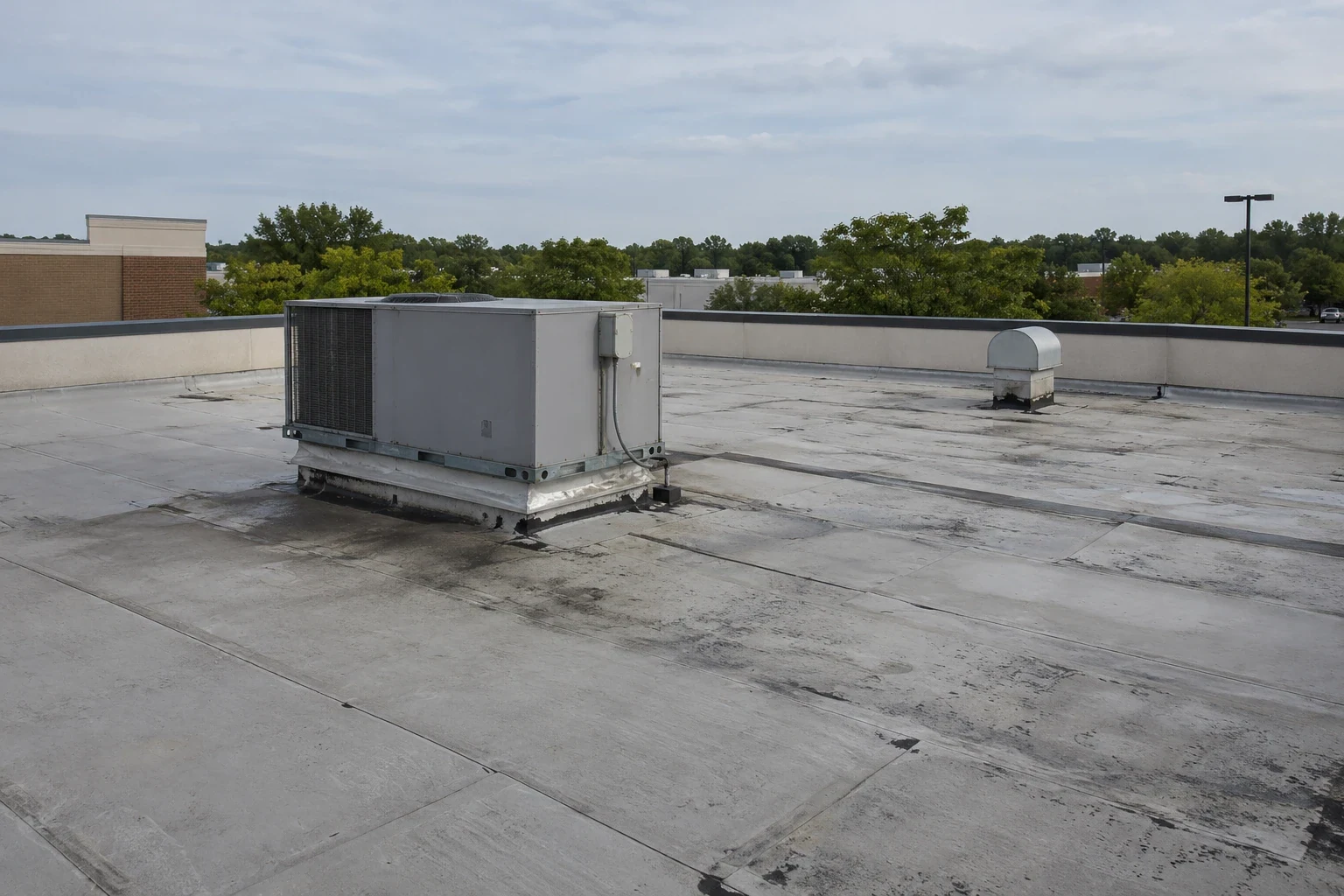
A broad flat roof has a lot of water to move. In a year with 53.5 inches of rain, one clogged drain is enough to put inches of water on a section of membrane. We measure the ponding, clear every drain and scupper, and recommend tapered insulation or an added drain where water stays. Heat adds to the problem: the record high is 107 F, and a membrane surface that hot softens and moves. Rooftop unit curbs, skylights and smoke vents are checked each season for sealant that has dried out. Heat also affects the working day, and membrane welding stops when the surface is too hot to handle, so crews start early and finish seams before the afternoon.
Repair, recover or replace on a leased building
The lease decides who pays, and the roof report has to serve both parties. The tenant needs to know the building is dry and what the owner plans to do about it, and the owner needs a scope that matches the lease. We give both the same ranked list, separating routine repair from capital work. A dry roof with local failures is a repair candidate, sometimes followed by a coating once seams and curbs are corrected, a dry roof with a sound deck can take a recover, and wet insulation across much of the roof is a replacement, staged by bay. Property teams that manage several leased buildings for different owners, as property management companies do, can use one scope format across all of them.
What to carry on the books
For each building, a 3PL or its landlord should hold the roof sections, the system, the age, the equipment on the roof, the last core cut and the punch list. Neighboring types such as warehouses and distribution centers use the same format, as do manufacturers that share a park. A multi-site roof program keeps several leased buildings on one calendar, with the same photographs, the same ranking and the same cost-to-leave-alone figure for each, which makes it easier to compare a cross-dock in one park with a bulk warehouse in another.
Customer contracts add a layer to the roof file. A 3PL that stores a customer's product under a section of roof is often responsible for keeping it dry, so the report ties each roof section to the aisles below and notes which customers' goods sit there. If a leak does reach product, the file shows the section, the date of the last inspection and the repair history, which is where a claims conversation starts. Temporary protection over high-value aisles is staged before storm season and not after the first leak.
Commercial Roofing Questions
Can dock doors stay open during a reroof?
Usually yes. We stage at the end of the building where trucks do not turn and work in strips that are sealed before the shift ends.
Who pays for a roof repair on a leased building?
The lease decides. Our report separates repair from capital work so the tenant and owner can apply the lease terms.
How do you protect racking and product?
By asking which aisles are most sensitive, working those bays first or last and drying in every strip before the day ends.
What is the most common leak on a distribution roof?
Dock edges, canopy attachments and rooftop unit curbs. Ponding at a clogged drain is next.
Do you check wind-uplift rating?
Yes. We record it for each section and run a pull test where no rating is on file.