
Manufacturing Plant Roofing in Tuscaloosa, AL
Standing on a supplier plant roof, a superintendent finds a membrane that has been working harder than the one on a plain warehouse: exhaust stacks discharging warm air onto the sheet, makeup air units on heavy curbs, process piping that crosses the roof and a deck that has carried years of vibration. Our crews repair, recover and replace manufacturing plant roofs in Tuscaloosa, AL, and we record what the production floor adds to the roof, section by section, so the asset manager can plan capital around real conditions.
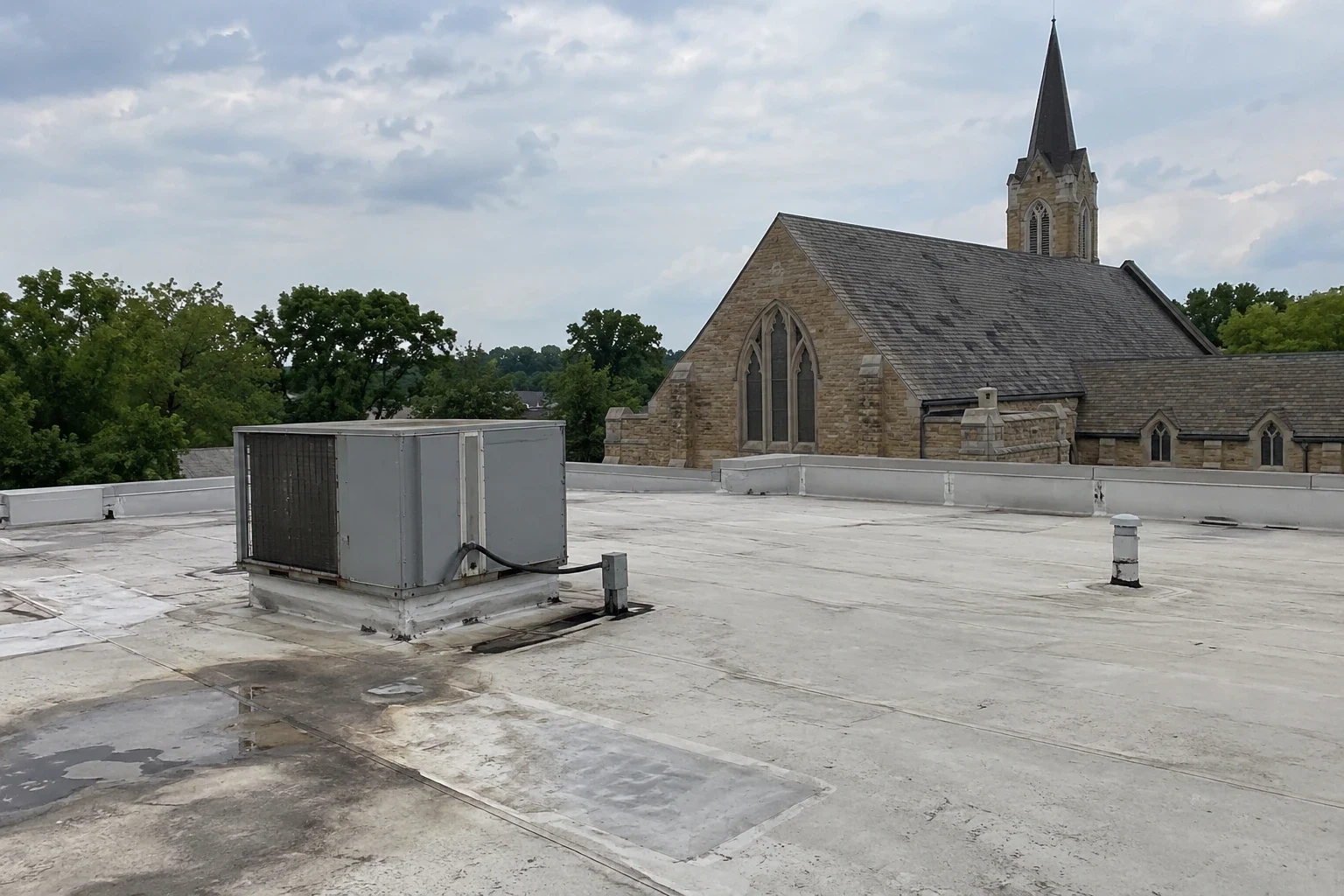
Process Exhaust, Piping and Heavy Curbs
A plant roof is a platform for equipment. Dust collectors, fume exhausts, cooling towers, makeup air units and electrical conduit all sit on or pass through it, and each needs a curb, a boot or a support. The more of them there are, the more the roof's performance depends on flashing quality, not on the field of the sheet. We count and map every penetration, then rate the flashing on each one.
Exhaust composition matters too. Warm air carrying oil mist, solvent vapor or fine dust can soften certain membranes near the discharge, stain the surface and clog nearby drains. Where the exhaust is aggressive, a membrane with better chemical resistance, such as PVC or KEE, may be the sensible choice, and we discuss that against the budget with the plant engineer.
A flex industrial building or a warehouse gives the crew mostly open field. On a plant the equipment dominates, and the survey time goes to the details, not the sheet. We photograph every curb from two angles, record its height above the membrane and note whether the counterflashing laps are intact.
Vibration, Heat and Wear Patterns
Mechanical vibration travels through the structure to the roof deck, loosening fasteners and cracking sealant at supports. We check fastener plates with a pull test on a few spots, look for raised plates and examine the sealant at every pipe and conduit penetration. A brittle sealant bead is a small repair now and a wet insulation problem after a few summer storms.
Heat is the second pattern. Tuscaloosa's record high is 107 F, and a dark patch of membrane near a discharge can run far hotter than its surroundings. Heat softens some materials, dries others and speeds the loss of plasticizer. We probe seams near hot discharges first and note any area where the sheet has crazed, shrunk or pulled from its flashing. The report lists those spots with photographs and a recommended correction.
Drainage is the other recurring finding. Process debris, lint and dust collect in sumps and scuppers, and a half-clogged drain turns a ten-minute storm into a ponding event. We clear and inspect each drain, note whether strainers are present and mark any low area for correction. Where a roof sees heavy debris, a scheduled cleaning visit costs far less than a repair to saturated insulation.
Wind Exposure on Large Plant Roofs
A plant on open ground has little to block the wind. Warehouses were destroyed in the 35th Street industrial area by the 2011 EF4, and gusts of 90 to 100 mph reached north of Northport in May 2025, so every plant roof section needs its edge metal, perimeter attachment and wind-uplift rating written into the asset record.
Edge metal fasteners, joints and the membrane rows nearest each corner get inspected by hand, and added attachment is recommended wherever the evidence calls for it. A written wind-uplift note per section gives the asset manager and the insurer a clear baseline, and a wind damage roof repair after any event is compared against it.
Plant Settings Around Tuscaloosa County
Near Vance, about 19 miles east of downtown Tuscaloosa, Mercedes-Benz U.S. International fills 1,000 acres, and the Cedar Cove Technology Park spreads over 950 acres at Progress Drive and Ed Stephens Road, a mile from I-59. Mercedes supplier SMP Automotive Systems planned a 700,000 square foot facility in the technology park. The county's employers also include Michelin/BF Goodrich, Phifer, Nucor Tuscaloosa, Hanna Steel and Hunt Refining.
With production buildings of so many kinds in the region, a roof program starts with a survey, not an assumption. A building in the Cedar Cove Technology Park area gets the same walk as one in the Airport Industrial Park.
Reroofing Without Stopping Production
Plant reroofing is planned with the plant engineer. We agree on shutdown windows for exhaust and makeup air, dust and debris control over sensitive processes, crane position, truck routes and hot work permits. Work is split into sections that can be dried in each day, and interior protection is installed below any area being opened. If a process cannot tolerate overhead noise at certain hours, the schedule moves around it.
Insulation and wind requirements are confirmed with the building department before pricing. The plan follows the pattern of reroofing an occupied building, with a punch list and a warranty walk at the end.
Timing around plant calendars helps. Annual shutdowns, model changeovers and inventory periods give natural windows for the noisiest and most disruptive tasks, and we ask for those dates at the first walk. If the plant has no window long enough, the work is divided into smaller sections across several weeks, each completed and dried in before the crew leaves.
What to Carry on the Books
A plant roof is a capital asset tied to production, and its failure can stop a line. We give each roof section a condition rating, an estimate of remaining service as a range and a short list of corrective items. The record notes the equipment each section carries, the exhaust type and any change since the roof was built, so the next survey starts from a known configuration.
Where several plants or lines share a campus, the roof asset management record ranks sections by consequence of failure as well as by condition. A small leak over a control room or a clean process ranks above a larger one over an idle bay, and the capital plan follows that ranking.
Insurance and lender reviews also draw on the record. A dated survey with photographs shows the condition before a loss, which supports a claim and answers the question of what was already worn. We keep the report format consistent from visit to visit so changes in condition can be read at a glance.
Plant managers also want the walk to produce a short list for the next shutdown. The report ends with the items that fit inside a planned outage and the items that need a window of their own, so the maintenance calendar and the roof calendar can be set side by side.
Commercial Roofing Questions
Does process exhaust change the membrane I should choose?
It can. Oil mist, solvent vapor and heat attack some membranes. We review the exhaust with the plant engineer and recommend a material suited to it.
Can the roof be replaced while the plant runs?
Yes. We plan shutdown windows, protect interiors and close sections daily. The plant engineer approves the sequence before work starts.
How do you handle hot work near process areas?
With permits, fire watches and a method chosen for the building. Where open flame is a concern we use cold-applied or mechanically attached alternatives.
What does vibration do to a roof?
It loosens fasteners and cracks sealant at supports. We pull-test fasteners and rebuild details that keep failing.
What should the record include after the work?
The roof plan, system type, equipment locations, repair log and photographs. It lets the next inspector match the roof to its history.