Wind Damage Roof Repair in Tuscaloosa, AL
On a mechanically attached single-ply roof over a steel deck, a superintendent who finds a flapping corner is usually looking at the last thing to fail, not the first. The first is almost always a length of edge metal that lost its cleat, or a row of fasteners along the perimeter that backed out under repeated gusts, and once the membrane edge lifts, the wind works inward along every seam. Wind damage roof repair in Tuscaloosa, AL begins at the perimeter, follows the fastener rows toward the field and ends with a numbered list of roof sections, each with a condition, a repair and a cost to leave alone, so the asset manager can carry the findings on the books.
Perimeter First: Edge Metal and Cleats
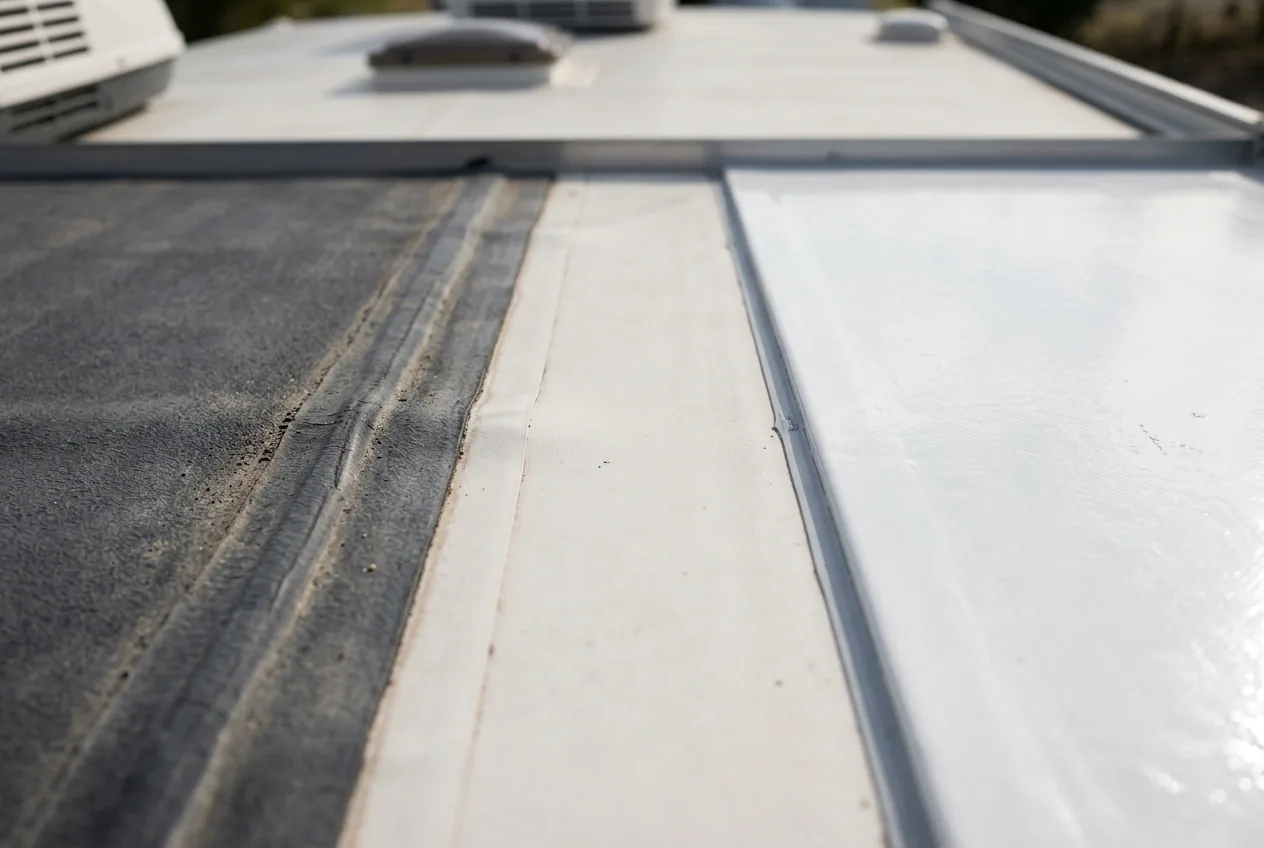
Uplift concentrates at corners and along the edges, where air piles up against the wall and tries to peel the roof from the outside in. We start with the edge metal because a bent, bowed or open coping joint gives the wind a lip to grab. Each run is checked for missing fasteners, split sealant, loose cleats and gaps at the corners, and we mark every defect on the roof plan with a number.
Cleats are the part most often missed. A cleat is the continuous metal strip that locks the edge metal to the wall, and when it is corroded, short-fastened or bent, the whole run can release in one gust. We check cleat spacing and fastener condition along the full length, not only at the visible damage.
The membrane edge comes next. A sheet that has been tugged for a season may look closed from standing height and open at the touch of a fingertip, so we probe the laps for several feet in from each corner. If the metal and the edge of the sheet are repaired together, the repair holds. If only the visible tear is patched, the next gust finds the same weakness, which is why an edge metal and coping repair is part of nearly every wind scope.
Fastener Pull Tests and the Deck Beneath
A fastener holds only as well as the deck it grips. After a wind event we pull a sample of fasteners across the roof, concentrating on the perimeter and corner zones, and record which ones release below the expected value. A steel deck that has rusted at the flutes, a wood deck that has softened or a lightweight concrete fill that has crumbled will each give a low reading, and the repair then has to deal with the deck and not only the fastener.
Low pull-test results change the scope. A few failed fasteners are replaced and a row is added. A pattern of failures across a section means the attachment has to be redesigned to a higher wind-uplift rating, which can mean a new fastening schedule, more rows at the perimeter or a section of commercial roof replacement. We bring the results to the owner with a number for each section, so the choice is made on data.
Deck condition matters in a second way: a deck with surface rust or a damp wood panel is also telling us that water has been entering for a while, so the pull test and the moisture scan are read together. Where the readings disagree with the roof's age, we cut a core and look at the layers directly before any scope is written.
What Tuscaloosa Wind Has Done to Roofs
Tuscaloosa's roof stress is wind more than any other force. In May 2025 a National Weather Service survey measured straight-line gusts of 90 to 100 mph over ground north of Northport, in a swath that ran nearly four miles wide west of US 43. Near Samantha, an EF1 tornado in March 2007 (estimated 105 mph) crossed US 43 and peeled part of the roof off a brick home, while the 2011 tornado, estimated at 190 mph, tore through the warehouses on 35th Street.
Not every wind event is a tornado, and the damage differs. Straight-line wind lifts membranes and strips edge metal across a broad area, while a tornado tears at roofs along a narrow path with extreme force; for that case the tornado damage scope applies. We read the pattern on the roof to tell the two apart and match the repair to what the storm did.
Gravel, Ballast and Loose Components
Roofs that rely on ballast or loose-laid sheets fail differently. Stone is scattered across the surface or stacked at one wall, and the sheet beneath may have rolled back at a corner. Rooftop unit panels, vent hoods and lightweight curb covers can detach and strike the membrane, and we check every piece of equipment for loose screws and missing latches.
Wind also moves debris. A sheet of metal from a neighboring building or a branch from a parking lot can land on a roof and cut it, which is why a wind scope includes a pass for punctures near the downwind edge. Where equipment moved, the supports and the rooftop unit curb flashing are re-checked, since a shifted unit can open a seam even if the sheet looks whole. A torn counterflashing at a wall or curb is repaired as a flashing failure in the same visit.
Temporary Repairs, Records and the Permanent Scope
The first visit after a storm secures the roof: we strap or batten lifted edges, close open seams with temporary seals and cover any exposed insulation. Emergency roof repair is available at any hour, and each temporary measure is numbered on the plan so it can be removed when the permanent work starts.
The record that follows is what the asset manager keeps: dated photographs, the pull-test results, the roof section map and the repair scope with cost ranges. It supports the claim, the warranty file and the next budget cycle. Larger repairs and replacements are checked against the state code, the 2021 IBC in force since July 1, 2022, before work begins. The same file lists which sections need a second visit after the next major wind, so the roof is inspected on a schedule and not only after damage.
Commercial Roofing Questions
What fails first on a wind-damaged roof?
Usually the edge metal or the perimeter fasteners. Once the edge lifts, wind works inward along the seams and the membrane peels. We repair the perimeter first, then the field.
Is a lifted corner a repair or a replacement?
A single lifted corner with sound fasteners and deck is a repair. A pattern of low pull-test results across a section points to replacement of that section.
Do you test fasteners after a storm?
Yes. We pull a sample along the perimeter and corners and record the values. The results decide whether the attachment needs new rows or a new schedule.
How fast can a storm-opened roof be made watertight?
We dry in the same visit when access allows, with straps, temporary seals and covers. The permanent scope follows once the owner has the findings.
Does wind damage affect a manufacturer warranty?
It can, depending on the wind limit in the document. We read the warranty before repair, note the storm date and send any notice the document requires.
How do straight-line winds differ from a tornado on a roof?
Straight-line wind lifts and strips across a wide area. A tornado tears along a narrow path with greater force. The pattern on the roof shows which one we are repairing.