
Tornado Damage Roof Repair in Tuscaloosa, AL
On a low-slope commercial roof, the superintendent who climbs up the day after a tornado is not looking for a leak first, because the first question is whether the deck underneath will still carry a crew, a pallet of materials and a lift. Everything that follows, from the dry-in to the insurance file to the decision between patching and tearing off, depends on that answer, so we start with the structure and work upward through the insulation, the membrane and the edges. Tuscaloosa, AL has a particular reason to treat the sequence seriously. On April 27, 2011 an EF4 tornado came through with estimated 190 mph winds, 1.5 miles across at its widest.
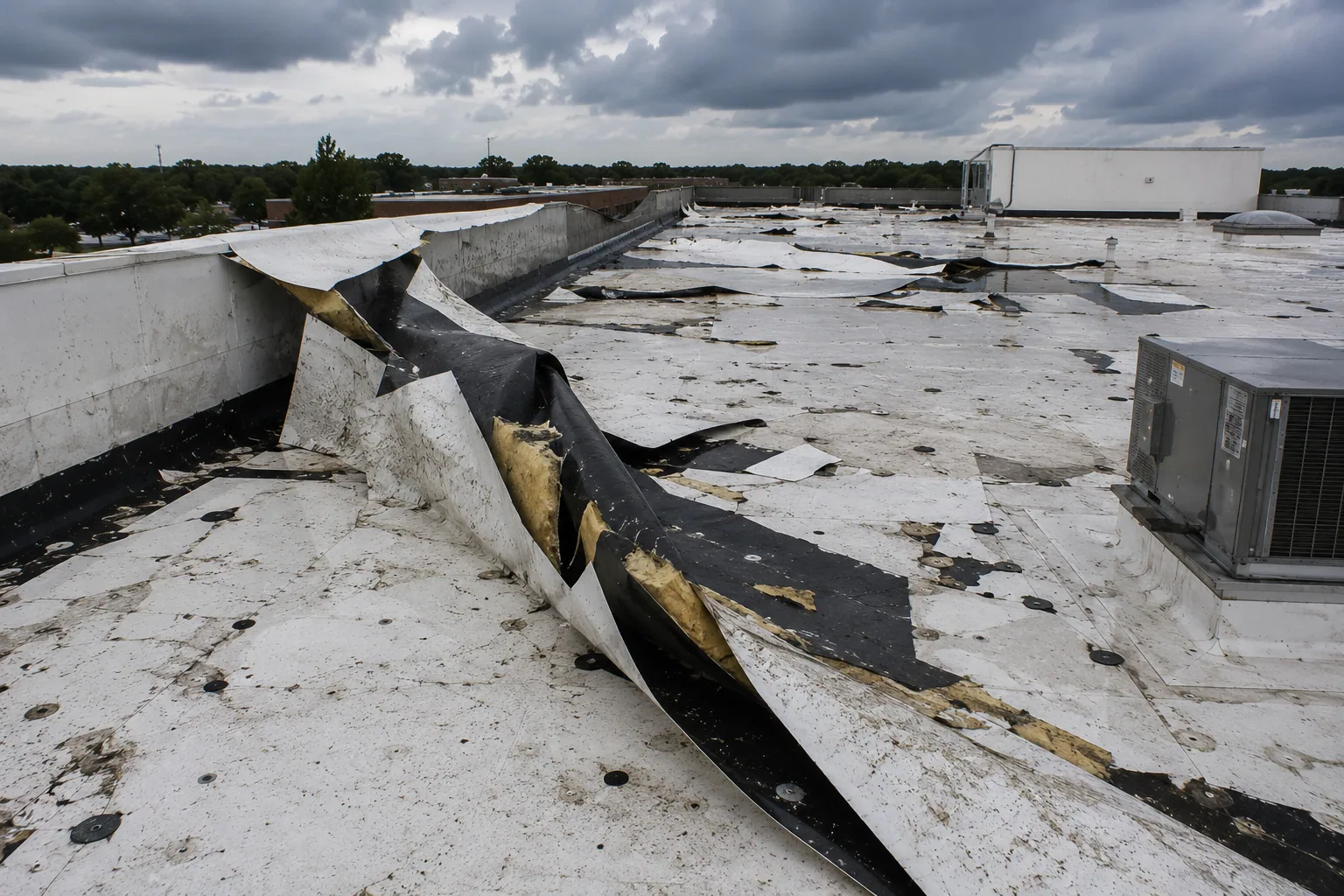
Tornado damage to a roof is rarely one problem. It is wind uplift, flying debris, pressure change and water entry arriving together, and each has to be sorted before a price means anything.
Deck Condition Before Anything Else
A roof that has lost its membrane in a strip can sit on a deck that is sound, and a roof that looks intact from the parking lot can sit on a deck that has been lifted off its supports and set back down a fraction of an inch out of line. We walk the sections slowly, look for waves in the surface, open seams in metal deck, bent purlins and fasteners that have pulled through, and mark any section where a person should not stand. Where the deck is in doubt, work stops and a structural engineer is asked to look before the crew goes further.
Steel deck can often be repaired by fastener replacement or panel splicing, while wood or concrete deck may call for cutting out the damaged portion. We record each decision on the roof plan, because the deck finding shapes the insulation scope, the attachment pattern and the order of work for everything above it.
Debris Impact and Hidden Holes
A tornado turns everything loose into a projectile: gravel, sheet metal, lumber, pieces of neighboring buildings and rooftop equipment. Impact damage shows on a membrane as punctures, gouges, torn flashing and dented edge metal, and the holes are often hidden under debris that has landed on them. We clear the roof section by section, photograph what we find in place before moving it, and probe the membrane under every piece of debris.
A puncture that stays open lets water into the insulation, where it travels far from the hole. Our approach to membrane puncture repair applies here, with the added step of checking the insulation beneath each hit with a moisture meter or a core cut. A drone pass helps on large roofs where walking every square foot is slow and unsafe, and the images go into the same file as the photographs taken on foot.
What the 2011 Path Taught the Industrial Corridors
The 2011 storm destroyed warehouses in the industrial area at 35th Street before it passed over 15th Street and McFarland Boulevard and damaged Cedar Crest and Alberta City. The National Weather Service survey puts the damage path at about 80.68 miles, from northern Greene County through southern Tuscaloosa County into western Jefferson County. For an asset manager that figure makes one point plain: a single storm can reach buildings of every type along its route, from industrial to retail to institutional.
Smaller tornadoes matter as well. Two smaller storms are on record. In March 2007 an EF1 estimated at 105 mph crossed US 43 close to Samantha and stripped part of the roof off a brick home, while an F0 in April 2005 started near Northport, west of the CR 86 and US 43 crossing, and covered about 6.75 miles toward Lake Tuscaloosa. Those two events did not match 2011 in strength, and they show that roofs here have been tested by more than one storm.
Emergency Dry-In at Scale
After a tornado every damaged building needs a temporary cover at the same moment, so the crew has to sort by risk. We rank sections by what sits beneath them: stock that cannot get wet, electrical rooms, occupied suites, and equipment that runs the building. Those sections get tarps, temporary membrane or spray-applied cover first, and the remainder follow in order. Our emergency roof repair service is built on that triage.
A temporary cover on a damaged roof must be fastened to something sound. On a roof with a lifted deck or torn insulation, we may need to pin the cover to the structure and not to the membrane. We note every temporary measure on the plan with the date and the material used, so the permanent scope can account for it, and so the next storm does not catch a cover that has quietly come loose.
Permanent Scope and Replacement Thresholds
Once the building is dry and the deck is cleared, the scope divides roof sections into three groups: repair in place, partial tear-off with new insulation and membrane, and full replacement. The dividing line is the share of the section that is damaged, the condition of the insulation, and whether the original attachment can be trusted. Where the perimeter has also lifted, the wind damage repair steps for edge metal and cleats apply to the same section. Wet or crushed insulation rarely returns to service, and a membrane torn across several lap lines usually costs more to patch than to replace.
When a section is replaced, the new assembly is specified to the code in force. The adopted 2021 International Building Code, as amended in 2025, governs a replacement. That affects wind-uplift rating, edge metal and attachment, and we confirm the local authority's requirements before pricing. Our commercial roof replacement scopes state the uplift rating of each section in writing.
Claim Records and Ranked Summary
A tornado claim is won or lost on documentation. We photograph each roof section before any work, label the damage on the roof plan, record moisture findings, and keep dated notes of every temporary measure. Pre-storm roof reports, where they exist, are compared with post-storm conditions so that damage from the storm is separated from age and wear. Our roof insurance claim assistance assembles those pieces into one file for the adjuster.
For a portfolio, the final product is a ranked condition summary: building by building, section by section, with the repair cost, the replacement cost and the cost of leaving it alone. Buildings in Rosedale and the 35th Street area or Alberta City are listed in the same format as any other, so the owner can fund the highest-risk sections first.
Commercial Roofing Questions
Is the roof safe to walk right after a tornado?
Not until the deck has been checked. Lifted or buckled deck can fail under a person's weight. We inspect from the edge or with a drone first and mark any section that must stay clear.
Can a tornado-damaged roof be patched?
Sometimes. If the deck is sound, the insulation is dry and the damage is limited to a few areas, patching holds. Wide membrane tears, crushed insulation or a shifted deck move the section toward replacement.
Why do you probe under debris?
Because debris often lies on the hole it made. Lifting it first without a photograph loses the evidence an adjuster wants, so we shoot the debris in place, clear it, then probe the membrane beneath.
How quickly can a temporary cover go on?
As soon as the crew can reach the roof safely. Sections protecting stock, electrical rooms and occupied suites go first, and the rest follow by risk order.
Does the uplift rating change when a section is replaced?
It can. The new assembly is specified to the code in force, and the corners and perimeter of the section usually receive the heaviest attachment. We state the rating in the written scope.
What does the owner get at the end of the work?
A ranked summary of every roof section, the photographs behind it, the temporary and permanent measures taken, and a list of items to watch before the next storm season.