
Roofing for Manufacturing Companies in Tuscaloosa, AL
A superintendent on a plant roof reads the building by what it vents: exhaust stacks, make-up air units, dust collectors, process fans and a run of conduit and piping that crosses the membrane on skids. A plant roof is rarely a quiet field of single-ply, and the leaks tend to start where something was added. Tuscaloosa County has a deep manufacturing base, with Mercedes-Benz U.S. International at 4,500 employees, Michelin/BF Goodrich at 1,378, SMP Automotive at 1,246 and Phifer at 1,099, along with Nucor Tuscaloosa, Hunt Refining and Hanna Steel, and the plant manager at any of them has to decide when a roof can be worked on without costing a shift.
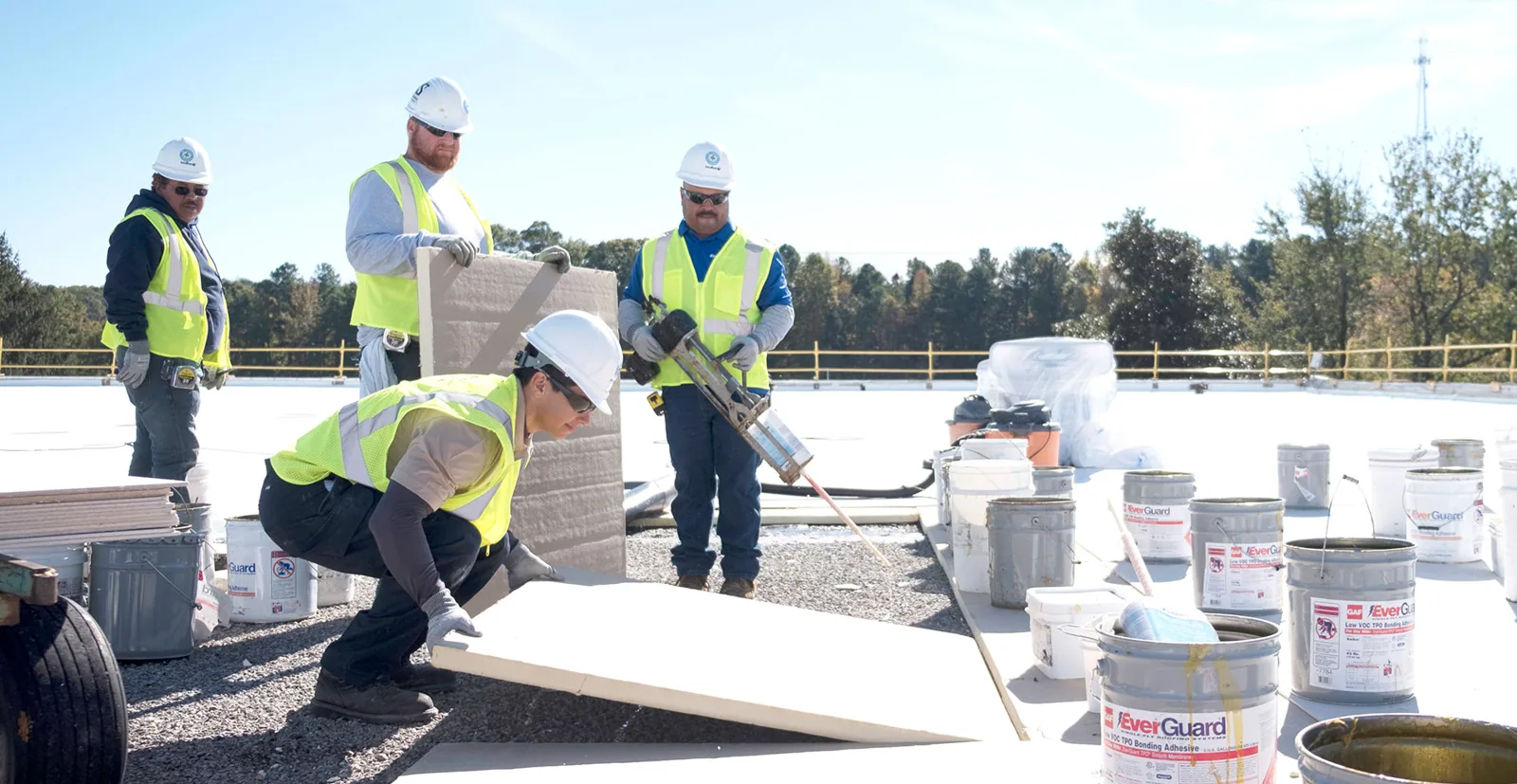
What a plant roof walk looks for
We begin with the equipment, because it is where the process meets the weather. Each stack, fan and curb gets a check for flashing height, sealant, a proper cap and a base that has not worked loose. Then we look at the membrane around each piece, since discharge from process exhaust can be hot, damp or chemical, and a sheet that is fine across the field can be stained, softened or etched within a few feet of a vent. Piping and conduit lying directly on the membrane are another repeat offender: they rub through the surface over the years and trap water beneath them.
We cut a core where the insulation feels wrong. A wet core in a plant roof is often a long-running leak from a curb or a drain, and the repair has to remove the wet material, correct the cause and restore slope to the drain sump, not just cover the stain.
Production windows and the work zone
A plant does not stop for a roof, and some processes cannot stop at all. The first question we ask is which areas of the roof sit over operations that cannot be disturbed, such as paint lines, furnaces, clean assembly or controlled-atmosphere rooms, and which can tolerate noise and vibration at certain hours. We map the roof against the plant's shifts, planned shutdowns and holiday schedules, then place the loud, dusty or hot work for the windows the plant manager approves.
The lift, the crane and the material stack go where trucks and forklifts do not pass. Fire lanes and gates stay open, hot work is controlled under the plant's permit, and exhaust discharge near the work zone is discussed with the engineer so that the crew is not working in the plume. The plan for reroofing an occupied building states the order of sections and the person who can stop the work. At the end of a shift the crew leaves a written note for the shift supervisor: which section is open, which is sealed, where the temporary protection sits and what the next shift will find overhead.
Process exposure and membrane choice
The wrong membrane near the wrong exhaust fails early. Oils, greases, solvents and some process vapors attack certain sheets, while other sheets shrug them off. A chemical-resistant PVC membrane is a common choice near grease and oil, a heat-welded TPO sheet suits large clean areas, and a metal roof may suit a plant where heavy equipment is mounted on framing. We ask the plant engineer for the exhaust list and any known chemicals, then specify a membrane, a walk pad and a cleaning routine that match.
Large plants, parks and the supplier base
Manufacturing land in the county runs from the 1,000-acre Mercedes-Benz plant at Vance, about 19 miles east of downtown, to Cedar Cove Technology Park, where SMP Automotive planned a 700,000-square-foot facility on 950 acres, to the Airport Industrial Park with its WATCO rail. Nucor Tuscaloosa makes coil and cut plate steel, Hunt Refining operates a refinery processing 52,000 barrels per day, and GAF Materials and Hanna Steel are also among the county's employers. A plant of any size needs its roof read section by section, and the Cedar Cove Technology Park and the Vance area are within our service territory.
Wind, rain and heat on long roofs
A plant roof is large and low, with a long perimeter. Warehouses in the 35th Street industrial area were destroyed by the 2011 EF4, estimated at 190 mph, and the weather service found 90 to 100 mph straight-line gusts after the May 2025 storm north of Northport. Wind-uplift rating and edge metal are checked on every section, a fastener pull test settles any doubt about attachment and the perimeter is heavied at replacement. Rainfall near 53.5 inches a year and highs to 107 F keep ponding and heat load in play, so drains and sumps are cleared before the wet season and curbs are checked after each summer. Dust is a quieter problem. Fine process dust that settles on a roof holds moisture against the membrane, clogs drains and adds weight, so plants with heavy settling need a washdown or sweep routine written into the maintenance plan, and the roof walk notes where the buildup is worst.
Repair, recover or replace
The plant manager's decision depends on moisture and layers. Where the roof is dry and the failures sit at seams and flashings, repair or a coating restoration is the usual answer. A roof with dry insulation and a sound deck can take a recover, which shortens the open-roof period. Where insulation is wet across much of the roof, replacement is the answer, staged by bay so production continues. We write each option with its cost and the cost of leaving it alone. Staging by bay means each strip is opened, dried in and inspected before the next begins, and the plant manager can pause the job for a rush order or a line trial without leaving an exposed edge behind.
What to carry on the books
A plant's roof file lists each section, the system, the age, the equipment on it, the exhaust list, the last core cut and the punch list. Related building types such as manufacturing plants, warehouses and flex industrial buildings share the format, and a logistics operator next door or a general contractor managing a plant expansion can use it too.
Expansions deserve a note of their own. A new bay, a new dust collector or a new line of equipment usually means new roof penetrations and a new tie-in between the old roof and the new, and the tie-in is where plants leak first. We review the drawings for curb locations and roof loads, ask that the roofing scope ride in the same package as the mechanical work, and walk the tie-in with the contractor before it is covered, so the plant does not pay twice for the same opening.
Commercial Roofing Questions
Can roof work happen during a production shift?
On some areas yes, on others no. We map the roof against the plant's operations and place loud or hot work in the windows the plant manager approves.
How do you protect the crew from exhaust?
By locating discharge points before the job, working upwind where possible and asking the engineer to adjust or pause fans near the work.
Which membrane resists oils and grease?
A chemical-resistant sheet such as PVC is common near grease and oil. We confirm the exhaust list before choosing.
What if a section is above a process that cannot be disturbed?
We plan it for a scheduled shutdown, add temporary protection and isolate the work zone with the plant's engineer.
How do we budget for a large plant roof?
With a section-by-section ranking, each section carrying its repair cost, replacement cost and the cost of leaving it alone.