
Data Center Roofing in Tuscaloosa, AL
On a data center roof, a superintendent finds a heavily loaded low-slope assembly, often a single-ply membrane over insulation and a concrete or steel deck, carrying chillers, generators, dry coolers and a lot of conduit, with electronics directly below the part that leaks. Water over live equipment changes how a roof is judged, because the cost of a drip is measured in downtime and not in repair hours. Our crews repair, recover and replace data center roofs in Tuscaloosa, AL, and our reports rank roof sections by what sits beneath them as well as by how the membrane looks.
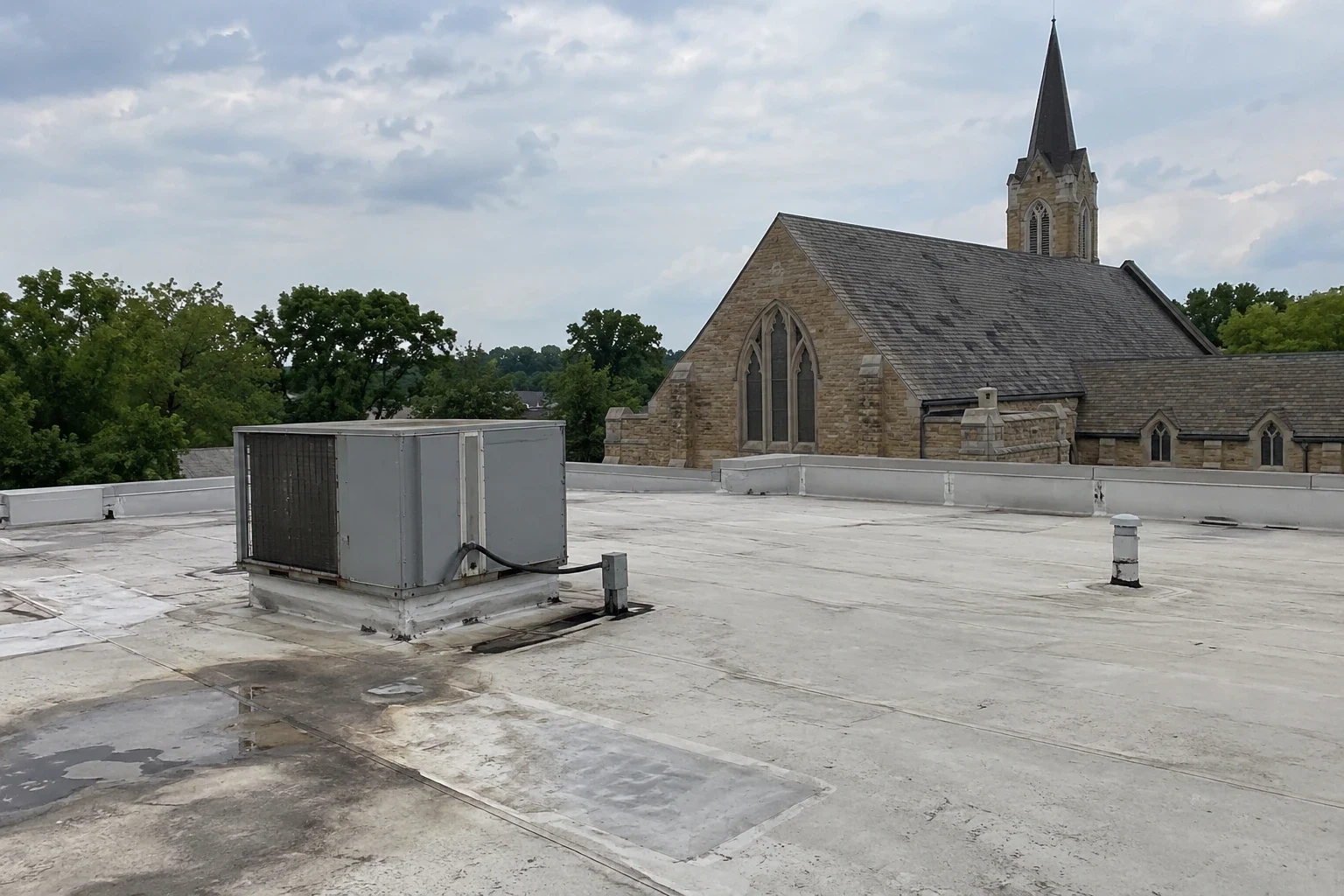
Equipment Platforms and Dense Penetrations
A server building concentrates mechanical equipment on its roof. Cooling plant, backup power exhaust, antennas, cable trays and structural supports all need a way through or onto the roof, and the penetrations multiply. Every one is a flashing to inspect, and every support is a load to confirm. We count and map them, rate each flashing and flag any that have been added without proper detailing.
Drainage is designed with more redundancy in mind. Secondary or overflow drains, scuppers set at the right height and clear sumps matter because a blocked primary drain on a heavily loaded roof can quickly become a structural and water problem. We test the flow, clear the sumps and check that overflow paths lead somewhere safe.
Structural capacity is part of the survey. Extra equipment added over the years may exceed what the original design anticipated, and we ask for the structural drawings or an engineer's note before recommending any new loads. Roof additions without that check are a common source of deflection, ponding and leaks that the facility team only notices years later.
Early Detection of Moisture
A data center can justify more frequent moisture scans than most buildings. An infrared scan, followed by a core cut where results are unclear, finds wet insulation before water reaches the ceiling. Some owners also install moisture sensors under the membrane or leak detection at the ceiling below, and we map the sensor layout against our findings so an alarm can be traced to a roof section.
The findings that matter most are small. A cracked pipe boot, a lifted corner patch, a seam that takes a probe tip or a membrane worn thin along a service path can each admit water. We log them with photographs and a repair recommendation, and the written report separates items that should be fixed now from those that can wait until the next maintenance window.
Wind History and Uplift Records
Wind has left its mark on Tuscaloosa. The 2011 EF4 tornado was 1.5 miles across at its widest, with winds estimated at 190 mph, and the May 2025 storm that blew north of Northport reached 90 to 100 mph in straight lines. A server building cannot afford a torn edge, so the wind-uplift rating, edge metal and attachment of every roof section go into the file.
We check fasteners at the perimeter, the integrity of edge flashing and the anchorage of equipment stands, and after any event we repeat the walk and compare it with the baseline. A storm damage roof repair plan starts from that comparison, and temporary protection is placed before any permanent work begins.
The tornado's path, from the warehouses on 35th Street across 15th Street and McFarland Boulevard to Cedar Crest and Alberta City, shows how one storm can reach several parts of the city, so a server building anywhere in the area should have a current roof record. In the 950-acre Cedar Cove Technology Park, a mile from I-59, each building is surveyed on its own, because the roof on one says nothing about the next.
Heat Load and Rainfall
Annual rain of roughly 53.5 inches and a recorded high of 107 F set the baseline. Heat from rooftop cooling plant adds to the summer surface temperature, and a membrane near a discharge can be exposed to more than the city's weather alone. We examine the sheet near exhausts and condensers for crazing, shrinkage and softened areas, and we check that walkway pads protect the routes technicians use.
Rainfall tests the drains. After storms, we look for ponding and for debris carried onto the roof, and our ponding water repair work corrects low areas with tapered insulation or additional drains. A reflective membrane, such as white TPO, helps reduce surface heat where the building and budget allow.
Working Above Live Equipment
Roofing over a live server hall is planned like a surgical procedure. Hot work may be prohibited or tightly permitted, so cold-applied or mechanically attached systems are often chosen. Dust and debris control, noise limits and fire watch are written into the scope, and sections are kept small so the roof is never open for long. The facility manager confirms access, escort and badging requirements before the first day.
The building department confirms code requirements before pricing, under the 2021 International Building Code the state has adopted. The same constraints that shape reroofing an occupied building apply here, with less tolerance: an office building can absorb a short interruption in a way a server hall cannot.
Contingency planning rounds out the scope. The plan names who can approve a stop, where temporary protection is stored, how the crew is reached after hours and which rooms are checked first if water is reported. With those answers written down before the first day, a surprise at the roof becomes a procedure instead of a scramble.
What to Carry on the Books
An asset manager should carry each roof section with its rating, its service-life range, the equipment below it and the consequence of a leak. The consequence ranking is what makes a data center record different: a modest defect over a critical room ranks above a larger one over a corridor. Our roof asset management record keeps those rankings current after each visit.
For a campus with several buildings in the Cedar Cove Technology Park or elsewhere, the register ranks buildings against each other and against comparable hospital roofing risks where continuous operation is the standard. The record should also state the monitoring in place, the inspection interval and the trigger that would move it, such as a storm, an equipment change or a sensor alarm. Written beside the condition rating, it shows an owner or a lender how the roof is being managed.
Alarm history is useful evidence. If a leak sensor has tripped, the date and location go beside the roof section it sits under, and the pattern over several seasons shows whether water enters at one detail or at several.
Commercial Roofing Questions
How often should a data center roof be scanned for moisture?
More often than an ordinary roof, typically at a set interval and after any storm. The roof's condition and the consequence of a leak set the schedule.
Is hot work allowed on a server building?
Usually it is restricted. We use cold-applied or mechanically attached systems where needed and follow the owner's permit rules.
Do overflow drains matter?
Yes. A blocked primary drain on a loaded roof needs a safe path for water. We test both drain types and clear them.
Can sensors replace inspections?
No. Sensors alert to water, while inspections find the cause and the defects before water arrives. We use both and match them.
Who handles escort and badging?
The facility manager sets the rules and we follow them. Requirements are confirmed before work starts and listed in the scope.