
PVC Roofing in Tuscaloosa, AL
Grease on a gray PVC sheet near a kitchen exhaust fan tells a superintendent more about the roof than the membrane color does, because that fan discharge is the chemical exposure the roof was chosen to survive and the place where a lesser membrane softens first. Our crews install, repair and replace PVC on commercial buildings in Tuscaloosa, AL, and we walk it the same way each time: seams, flashings, fan curbs, drains and edges, then a ranked list of sections for the asset manager's books, with the cost of leaving each one alone written beside it.
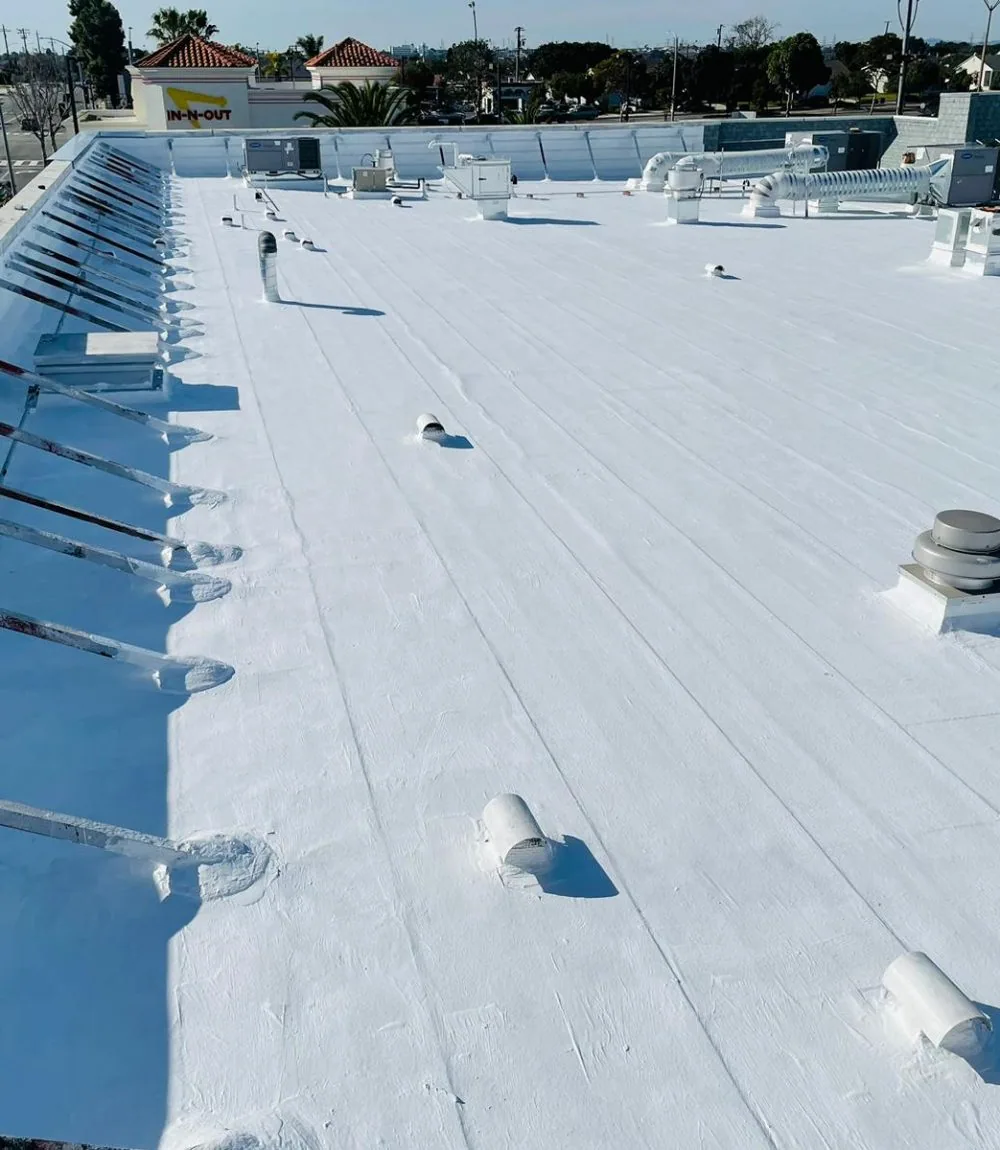
A Welded Sheet with a Chemical Record
PVC roofing is a polyvinyl chloride sheet, usually reinforced with polyester scrim, whose seams are fused with hot air so the laps become one piece with the field. The material resists many animal fats, oils and rooftop chemicals, which is why it is a common choice on restaurants, hospitals and industrial buildings with exhaust. It is installed over insulation and cover board and fastened or adhered like other single-ply systems. Because PVC is heavier and stiffer than some sheets, it is detailed with care at tight corners, and the welder works to temperature and speed settings checked against a test weld each morning.
PVC flashing is formed and welded in place around penetrations, and it can be cut and re-welded during a repair, so a leak at a pipe boot or a curb corner can be fixed with new material fused to the old.
Findings Around Exhaust and Penetrations
On an older PVC roof, we look for plasticizer loss that leaves the sheet stiff and prone to cracking at folds, welds that have crept at laps under heat, and grease deposits that clog drains or soak walkway pads. We probe the seams, press on the flashing at every corner, and check the drain sumps for debris.
Where the insulation below feels soft or spongy, a core cut reveals the moisture and the deck condition. A flashing split at a rooftop unit curb is the most common repair we find, and it is usually caused by movement between the curb and the sheet, not by the age of the field. We also check that grease traps on exhaust hoods are working, because a failed trap sends oil across the roof, and that walkway pads near the fan are still bonded and not carrying a layer of residue that could make the surface slick for technicians.
PVC on Restaurants, Clinics and Retail Roofs
Retail along McFarland Boulevard and 15th Street includes Shoppes at Legacy Park, University Mall and Midtown Village, and any restaurant in a center like those puts grease on the roof wherever its exhaust discharges. Healthcare adds its own demands: Northport Medical Center employs 1,761 people, DCH Regional Medical Center employs 3,444, and the VA medical campus holds 25 major buildings on 125 acres. Those facilities need roofs that can be repaired quickly with minimal disruption below.
The roof we find on any one of them is a field question. We record what is there before recommending anything, and for a clinical building we agree on infection control steps, quiet hours and the location of fresh-air intakes before the first section is opened. A flashing leak over a treatment area is handled as an urgent repair, and the permanent scope follows once the evidence is in.
Wind, Seams and the Roof Edge
A welded membrane resists wind better than a loose one, but wind still starts at the perimeter. Tornado and straight-line wind both matter. Winds were estimated at 190 mph when the 2011 EF4 crossed 15th Street and McFarland Boulevard, and the May 2025 gusts north of Northport, 90 to 100 mph, covered a belt close to four miles across. That history is why we record the edge metal, the perimeter attachment and the wind-uplift rating of every section.
A loose coping cap or a gap at the termination bar is a path for wind to get under the sheet. We fix those first, since a repair at the edge protects the whole field. A fastener pull test on the deck tells us whether the attachment can be trusted or needs reinforcing before a new sheet goes down.
Drains, Standing Water and Heat
A PVC roof must shed some 53.5 inches of rain a year and then take heat that has reached 107 F. Standing water on PVC is less damaging than on some membranes, but it still collects dirt and algae and stresses seams, and it can hide small punctures. We note ponded areas after a rain, clear drains and scuppers, and recommend tapered insulation when a re-roof is planned. Ponding near a drain sump often comes down to a clogged strainer, and that is cheap to fix; ponding in the middle of a bay usually means the deck has deflected and needs a design answer.
Heat movement is greatest at curbs and parapets, where the sheet turns up a wall. Flashings there should be fully welded and terminated with a bar and sealant that have not dried and pulled away.
Records for the Asset Manager
For each roof section we record the membrane type, thickness if known, the attachment, the age if documented, last inspection date, seam and flashing condition, repair count and an estimated service range. The ASHRAE/IES 90.1-2013 energy standard and Alabama's 2021 International Building Code (live from July 1, 2022 apart from listed exceptions) are what a PVC replacement is reviewed against.
Inspection findings feed our roof condition reports and the roof capital planning schedule, so a renewal can be placed in the right year. Each line carries the section, the finding, the likely action and the date by which a decision is needed, and sections that test dry and sound get a longer interval than sections with open seams or wet insulation. Photographs of each welded seam and each curb corner, dated at closeout, make the next inspection faster and the findings easier to defend.
Replacement Sequence on a Working Building
The replacement goes in section by section. Old membrane and wet insulation are stripped, the deck is mended, tapered insulation and cover board go down, the new sheet is fastened or adhered, every seam is welded and probed, and formed flashings are welded around each curb and pipe. The job closes with a punch list and a warranty walk. Temporary protection goes on any opening at the end of the shift, and weather checks come before each section is stripped, since a PVC sheet cannot be welded on a wet surface.
For restaurants and clinics, the schedule is set around service hours, and fresh-air intakes are identified before adhesives are opened. Owners weigh TPO and KEE sheets against it, and a kitchen exhaust makes the roof over a restaurant the clearest case for PVC. We serve the University Boulevard corridor and the rest of the city.
Commercial Roofing Questions
Why choose PVC for a restaurant roof?
It resists many fats and oils that attack other membranes, and its welded seams can be repaired by fusing new material to the old.
What is plasticizer loss?
The slow loss of softening agents that leaves PVC stiff. It shows as cracking at folds and corners, and it tells us how much service life remains.
How are PVC leaks repaired?
We clean the area, cut out the damaged sheet or flashing, and weld new material over it. The repair is probed and logged on the roof plan.
Does PVC need special care near rooftop units?
Walkway pads, curb flashing checks and clear drains matter most. Grease should be cleaned from pads and sumps on a schedule.