
Roof Capital Planning in Tuscaloosa, AL
A finance committee looking at a plant roof, three retail roofs and a clinic roof wants one number for next year and a range for the five after it, and the superintendent who has walked all five knows that the number depends on four things the committee rarely sees: how much of each roof is wet, how many seams are open, how the edge metal is fastened and whether the deck underneath can take a new system. Roof capital planning in Tuscaloosa, AL turns those findings into a schedule of replacements, recovers and repairs with cost ranges, so the asset manager can reserve money before a leak or a storm sets the date.
Replacement Timing From Condition, Not Age
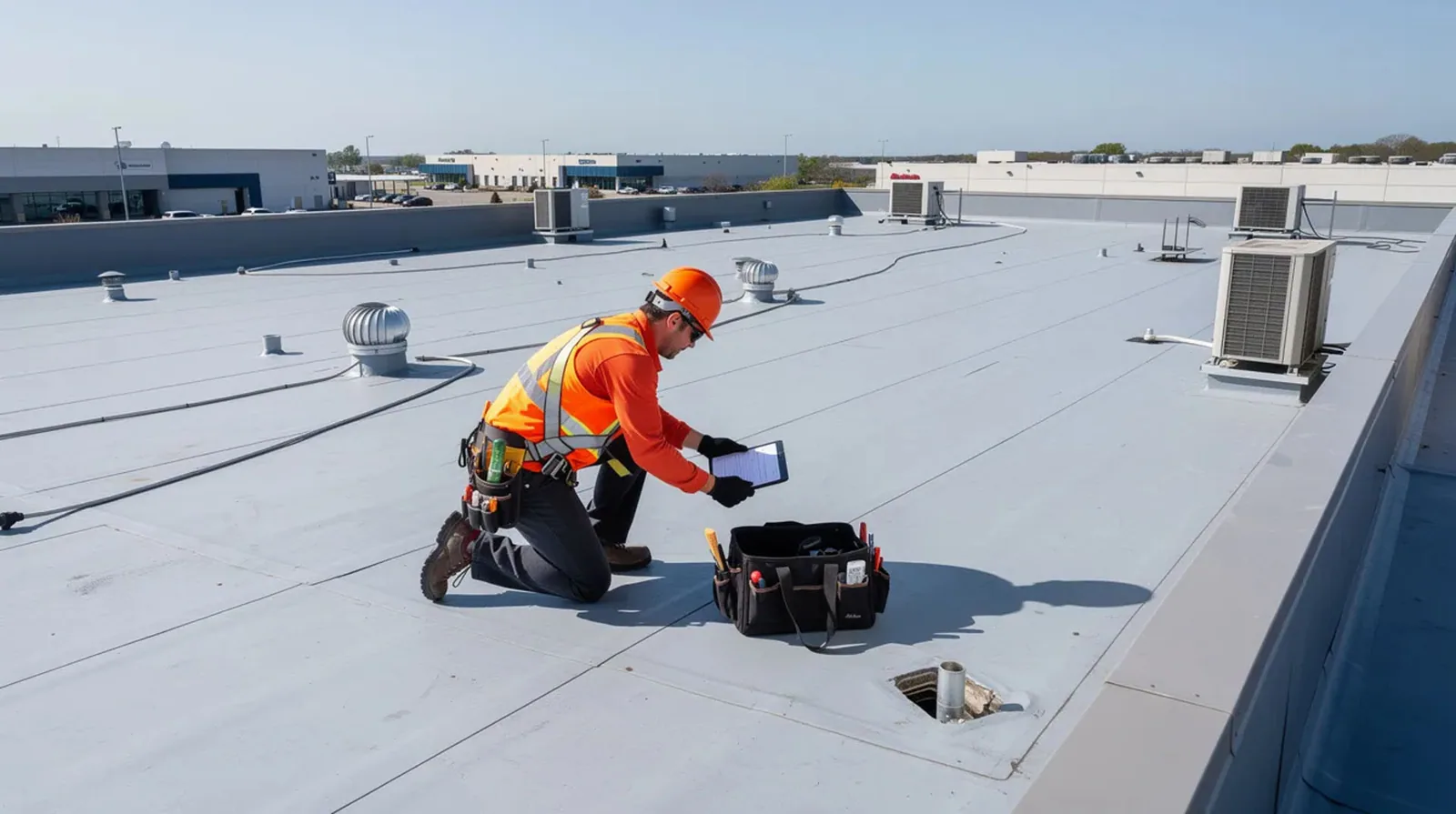
Age is a rough guide and a poor schedule. Two roofs of the same age can be in very different shape if one has had its drains cleared, its seams checked and its flashings resealed while the other has been left alone. We time a replacement from condition: moisture readings across the insulation, seam probe results, deck condition at core cuts, the number of repairs in the last two years and the trend in ponding.
Each roof section gets a remaining-life range and a trigger. The trigger is the finding that moves it from a repair program to a replacement: wet insulation across more than a set share of the section, seams that will no longer weld, a deck that has corroded at the flutes. The committee sees the trigger on paper, and a repeat inspection shows whether it has been reached. A roof asset management record supplies the data.
Repair history carries weight. A section that needed three patches in two years is telling the superintendent that the money is better spent on the section than on the fourth patch, and the plan shows the combined cost of patches beside the cost of replacement. When the patches cost more than a fraction of the new roof, the committee has a clear reason to move the date forward.
Budget Ranges and What Drives Them
We give ranges, not single numbers, because the roof can change before the work is bid. The range is driven by the area of each section, the type of system, the amount of wet insulation that must be removed, the number of penetrations and drains, the length of edge metal and parapet and the difficulty of access. A tapered insulation package to correct ponding adds to the total, and so does an upgraded perimeter to reach a higher wind-uplift rating.
Choosing between a recover and a tear-off is the largest swing. A recover over dry, firm insulation avoids tear-off and disposal, while a tear-off lets the deck be inspected and repaired. A core cut and moisture scan decide which one is available, and the plan shows both prices when the choice is open. Deck repair is carried as a separate line, because nobody knows its extent until the old roof is off. Contingency is shown openly, as a percentage of the section, and not buried in unit prices, so the committee sees what is held back for surprises and can release it if the deck is sound.
Wind, Heat and Rain in the Schedule
The weather sets the order of work. After a 2011 EF4 whose winds were put at 190 mph, and a May 2025 storm that sent straight-line gusts of 90 to 100 mph over the ground north of Northport, a section with a weak perimeter ranks above a sound one, whatever its age. With 53.5 inches of annual precipitation and a 107 F record, ponding and heat aging share a place in the same ranking.
We also schedule around the season. Large tear-offs are placed in months with the most stable weather, and storm-prone months carry smaller sections that can be dried in each day. A wind damage repair after a storm is entered as an event, with its cost and its effect on the remaining plan, so the schedule moves with the roof and not against it.
Sequencing Across a Portfolio
The sequence for a portfolio follows three rules. Roofs with active leaks over sensitive space go first. Roofs with failing perimeters or wet insulation go next, because their damage grows. Roofs with aging but sound membranes are placed late in the plan, with a monitoring date. Within each group, the order follows the cost of waiting.
Buildings can be grouped by trip. An owner who holds roofs in both the Tuscaloosa Airport Industrial Park and the Cedar Cove Technology Park can have the surveys and crews planned together, which saves mobilization on each project. Where an owner holds many roofs, a multi-site roof program applies the same sequence to all of them.
Code and Energy Requirements
A replacement can bring code requirements into the budget. Alabama applies the 2021 IBC (with exceptions) from July 1, 2022, and an amendment dated March 17, 2025 pulled in portions of the 2024 edition. Energy is a separate track. Alabama lists ASHRAE/IES 90.1-2013 as its commercial energy standard, and as of October 2024 the Licensing Board for General Contractors holds the authority to adopt a commercial energy code.
The effect on a roof is usually insulation: a full replacement can require insulation to a level the old roof lacks, and that adds to the price. We check the local building department's current requirements before the estimate, list insulation as its own line and show the owner what is required and what is optional. Better insulation also helps the roof's energy performance, which is a benefit the committee can weigh against first cost.
Reserves and Annual Review
The plan converts into a reserve schedule: a yearly amount per roof or per portfolio, with a note for each year about what will be done and what triggers an earlier move. It is reviewed after each storm season and revised when a roof's condition changes. The review is short, because the record is current, and it keeps the committee from being surprised. Each review closes with a punch list of open items, the date of the next walk and the person responsible for access, so the plan stays tied to actual visits.
For property management companies that report to several owners, the same plan can be split by owner. Each version shows the roofs, the grades and the reserve, in the same format, so a conversation with an owner starts from numbers and not from opinion.
Commercial Roofing Questions
Can a roof be scheduled by age alone?
Age is a rough guide. We time replacement from moisture readings, seam probes, deck condition and repair history, and set a trigger the committee can watch.
Why do you give ranges?
The roof can change before bid day, and deck repair is unknown until the old roof comes off. A range is more reliable than a single figure.
What decides recover versus tear-off?
A core cut and moisture scan. Dry, firm insulation allows a recover. Wet insulation or a damaged deck calls for tear-off.
How does the energy code affect the budget?
A replacement can require more insulation than the old roof has. We check the local requirement and list insulation as a separate line.
Does storm risk change the order of work?
Yes. Sections with weak perimeters rank above sound ones, whatever their age, because wind exposure is the dominant risk here.
How often is the plan revised?
After each storm season and whenever a roof's condition changes. The review is short because the record is kept current.