
Distribution Center Roofing in Tuscaloosa, AL
A distribution center roof is often a large white single-ply field, frequently TPO, laid over insulation board and a steel deck, with the wear concentrated at the dock side and around a few heavy rooftop units. The membrane seams run for hundreds of feet, and a defect anywhere along them can wet insulation far from the stain. We repair, recover and replace distribution and fulfillment center roofs in Tuscaloosa, AL, and we report them section by section so an asset manager knows which areas need money this year and which can wait.
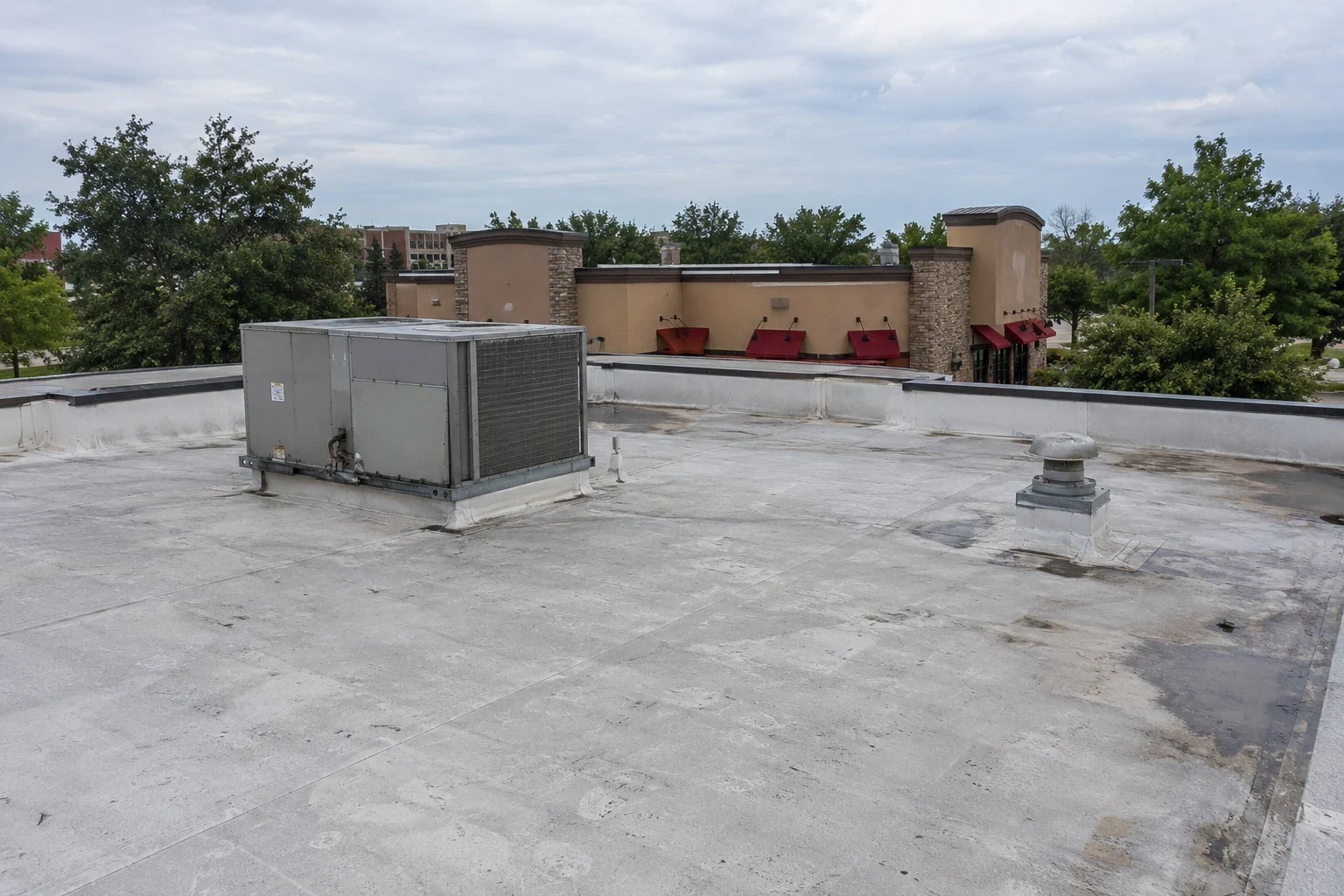
Large Fields and Heavy Equipment
The defining feature of these buildings is scale: a long roof with few interruptions, drained by interior sumps or perimeter scuppers, and carrying air handlers, exhaust fans and sometimes solar racks or conduit runs. Every one of those loads adds a curb or a support, and every curb is a place where flashing, sealant and membrane meet and move at different rates.
Because the field is so wide, minor slope errors matter. A shallow dip of a few inches can hold water well after a storm, and the membrane there takes more heat and ultraviolet exposure than the rest of the roof. We survey slope with a level or a laser, mark the low spots on the roof plan and note where tapered insulation or an added drain would solve the problem for good.
The same assembly appears on a warehouse and on a manufacturing plant, but fulfillment buildings usually add mezzanine exhaust, extra conveyor penetrations and more frequent rooftop service visits. Each addition shifts the inspection interval, so we ask what has been added since the roof was installed and compare the answer with the drawings.
Seams, Fasteners and Dock-End Flashing
A seam probe along the full length of a roof is slow, and it is the single most informative thing we do. A weld that takes the probe tip, or an adhesive lap that has opened, shows where water will enter. On a mechanically attached roof, we look for fastener plates that have raised the membrane, and a fastener pull test on a few spots shows whether the deck still holds them.
The dock end draws particular attention. Trucks, forklifts and sometimes canopies generate vibration and impact, and flashing where the roof meets a wall or a canopy tends to crack there first. We examine those joints, photograph them and list each as a patch or a rebuild. Our seam failure repair work includes test-welding a small area before a repair is committed.
Drains deserve the same care as seams. We clear each sump, check the clamping ring and strainer, and note whether the membrane has pulled away from the bowl, since a drain is the lowest point on the roof and the first place water will test a weak detail. Where a drain is overloaded, an added drain or a larger scupper is cheaper than repeated repairs around the old one.
Wind History and Uplift Ratings
A tornado rated EF4 destroyed warehouses in the 35th Street industrial area in April 2011 on its way toward 15th Street and McFarland Boulevard, and in May 2025 a different storm sent 90 to 100 mph straight-line wind across the county north of Northport. For a large flat roof, wind pressure is highest at corners and edges, so the wind-uplift rating, edge metal and attachment pattern belong in the asset record.
We check edge metal fasteners, joint laps and the first rows of membrane at corners, and we recommend added attachment where the roof shows flutter. The asset manager receives a section-by-section note of what was found and what was changed. After any event, a storm damage roof repair visit uses that record as the baseline for comparison.
Logistics Corridors in the Tuscaloosa Area
Five major routes cross the county, and the Airport Industrial Park sits off Robert Cardinal Road, with WATCO rail beside it, roughly 4.5 miles from the interstates. Buildings near those corridors move freight, and their roofs carry the traffic of trucks and rail indirectly, through dock activity, dust and exhaust.
Roof work on a logistics building is planned around truck access: staging areas, crane position, dock hours and fire lanes are agreed in advance. A survey for a building in the Tuscaloosa Airport Industrial Park follows that plan from the first day.
What to Carry on the Books
A distribution center roof is a large capital item with a replacement window that can be tracked. We provide a condition rating per section, a service-life range, a list of repairs that would extend it and a note on warranty terms where they apply. For a portfolio of such buildings, multi-site roof programs keep the records in one format so one building can be compared with another.
Cost drivers are plain: roof area, the number of curbs and penetrations, the amount of wet insulation, deck repair, edge length and the phasing needed to keep dock operations running. A recover over a dry roof is often the lower-cost option, and a roof recover estimate lists exactly what stays and what changes.
A distribution tenant often carries roof responsibility under a lease, so the record should say who maintains which section and when notice is due. Putting that beside the condition rating avoids a dispute at lease end, when a landlord and a tenant read the same roof differently.
Scope and Sequence Around Dock Hours
Work is divided into sections that can be closed each afternoon, with the dock side scheduled for the hours the operator picks. Before pricing, the building department confirms how the 2021 International Building Code the state adopted applies to wind and insulation on this roof. A summer that can reach 107 F is handled with early starts and shaded staging.
Closeout is a punch list, a warranty walk and a file entry for each finding, each repair and the date of the next look. If a fulfillment peak makes a particular month off limits, the scope version says so and the schedule moves around it.
Tenant improvements complicate the sequence. A racking install or a new sprinkler line can add roof penetrations after the roof is complete, so we ask the operator to flag any planned work before the membrane goes down. Finishing those penetrations at the same time as the roof keeps the warranty record clean and avoids cutting a new roof within its first year.
Dock-door counts and rooftop unit counts go on the first page of the file, since those two numbers predict where the roof will ask for attention first.
Commercial Roofing Questions
Does a distribution center roof need cores as well as a surface check?
Yes. The surface shows seams and flashing, while cores show wet insulation and layer condition. Both are needed before a repair or recover is priced.
Why is dock-end flashing a repeat problem?
Vibration and impact work on the joint between roof and wall or canopy. We rebuild it with a proper termination and fasteners instead of resealing over movement.
Can solar or conduit be added to a roof like this?
Yes, with planning. Supports need flashing and the added load must be checked. We document where each support sits so future work knows what is below.
How quickly can a leaking dock-side roof be covered?
Emergency crews respond day and night, every day. The first visit stops the water and records the opening, and permanent repair follows.
What decides recover versus tear-off?
Moisture and deck condition. Dry insulation and a sound deck allow a recover, and wet material means tear-off.