
Flashing Failure Repair in Tuscaloosa, AL
On a masonry office or institutional building with a parapet on every side, the superintendent who goes up after a ceiling stain usually finds the membrane in decent shape and the flashing where the sheet meets the wall opened by a half inch, with dried sealant hanging from the top edge and a stripe of dirt below it where water has been running down the face. Flashing failure repair in Tuscaloosa, AL starts at those transitions, because the field of a roof rarely leaks before its details do. We check every wall, curb, pipe and drain edge, mark each opening on the roof plan with a number and rebuild the detail so that it is mechanically sound and not only caulked.
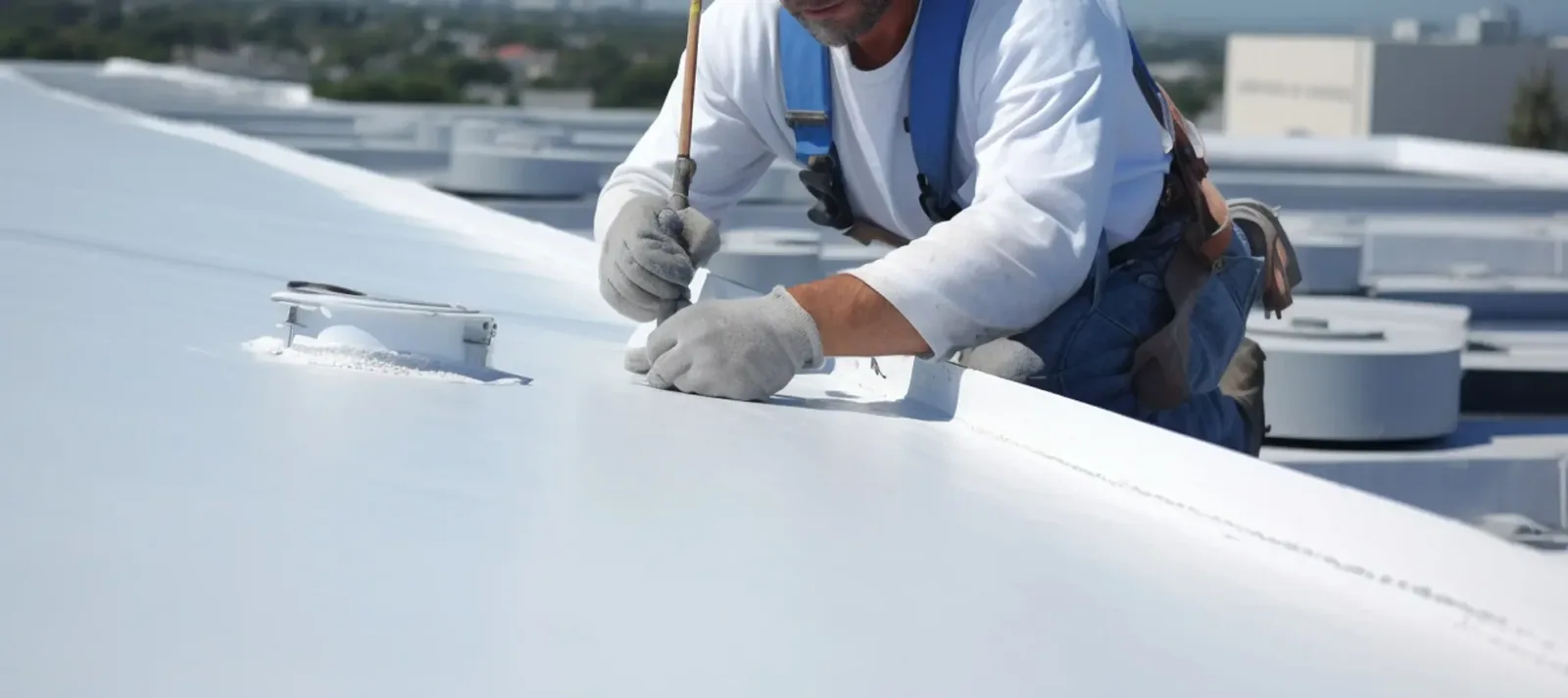
Wall Terminations and Counterflashing
The wall-to-roof transition has two jobs: it carries the membrane up the wall far enough to stay above standing water, and it covers the top of that membrane so water running down the wall cannot get behind it. The top is closed by counterflashing set into a masonry joint or fastened to a wall panel, and by a termination bar and sealant on a metal wall.
Failures follow a pattern. Sealant dries and splits at the top of the termination bar. Counterflashing pulls out of the mortar joint as the masonry moves. Base flashing slumps down the wall because the adhesive has aged. We probe each run, lift the counterflashing where it can be done safely and look at what is behind it. A repair resets the metal into a fresh joint or an installed reglet, adds a fastener row and finishes with sealant that is meant to be replaced on a schedule.
Height is the other check. Base flashing has to rise high enough above the roof surface to stay clear of standing water and splash, and a wall that was raised or a roof that was built up by a recover can leave the flashing too short. In that case we extend the base flashing up the wall and reset the counterflashing, which costs more than a bead of sealant and removes the weakness for good.
Penetrations, Pipes and Rooftop Unit Curbs
Every pipe, vent and conduit that passes through the roof is a possible leak, and every rooftop unit curb is a small wall with four corners. Pipe boots crack in the sun, pitch pans shrink and open, and curb flashing slumps where the unit's vibration has loosened the adhesive. Corners are the weak spot, because the membrane has to fold in a way that creates a seam in the thickest place.
Drain edges and scuppers are the third group. A drain bowl clamped loosely, a scupper liner lifted from the wall or a collar cracked by foot traffic all leak around the opening and not through it, so the sump is cleared and the flashing around it is checked every time the drain is cleaned.
We replace a failed pipe boot with a new one sized to the pipe, and we rebuild a pitch pan as a flashed penetration when the pan will no longer hold sealant. Around a rooftop unit curb we reinforce each corner with a pre-formed piece or a welded patch and confirm the curb is high enough to keep water out when a drain is slow. The skylight and penetration flashing scope covers the less common openings in the same manner.
Sealant, Cut Edges and the Limits of Caulk
Sealant is a maintenance item and not a repair. A bead along a termination bar lasts a few seasons before the sun and movement crack it, and a thick layer of roofing cement smeared over a failed flashing hides the problem for a rain or two. We remove old cement and failed sealant back to sound material, clean the surfaces and rebuild with a flashing that holds mechanically.
Where sealant is the right choice, we specify the type for the surface and the movement, and we tool it to shed water. Cut edges on a membrane, where a sheet ends without a lap, get a termination or an edge seal and not a smear. We keep a sealant log that lists the date, the material and the section, so the asset manager knows which joints are due before they open, and the record becomes part of the maintenance schedule.
Heat Movement and Flashing Fatigue
With 107 F on the record and roughly 53.5 inches of yearly precipitation, flashing here moves with heat and gets soaked by frequent rain. A metal flashing expands and contracts along its length, a membrane shrinks as plasticizers leave it, and the connection between them is stressed twice every day. Over years the stress shows up as hairline splits at corners, open laps and pulled fasteners.
We look for it with a hand on the surface and a mirror in the joint. Membrane shrinkage at a wall pulls the sheet away from the base, and a gap of a quarter inch can admit enough water to stain a ceiling. A seam failure at the base of a wall is often the same movement showing in a different place, so we repair both together. A leak repair that stops at the stain tends to return on the first hot week.
Edge Flashing and Wind
At the roof edge, flashing is also a structural part. Edge metal and gravel stops carry wind load, and they are fastened through the membrane to the deck. Straight-line winds of 90 to 100 mph struck north of Northport in May 2025, and an EF4 tornado estimated at 190 mph ran across the 35th Street warehouses in 2011, so an edge detail in this county has to be treated as a wind component.
When a flashing at the edge fails, we examine the fastener pattern, the cleat and the deck behind it, and we repair them as a unit with the wind damage repair. For buildings along University Boulevard or in downtown Tuscaloosa, any parapet wall and its coping are included in the same scope. The asset manager receives a section list with each flashing's condition, the repair and the sealant schedule.
Commercial Roofing Questions
Why does the flashing fail before the field of the roof?
Flashing is a joint between materials that move differently. Heat, wind and wall movement stress it daily, so it opens before the large flat areas of the membrane do.
Is roofing cement a legitimate repair?
It is a short-term seal. We remove failed cement and rebuild the flashing so that it holds mechanically, then keep sealant for the final line only.
Can a failed pipe boot be repaired in place?
Usually it is replaced. A new boot is sized to the pipe, welded or adhered to the membrane and sealed at the top, which lasts longer than a patch over the old one.
What does a termination bar do?
It fastens the top edge of the base flashing to the wall and gives the sealant a firm backing. When it is loose or corroded, water runs behind the flashing.
How long does a flashing repair take?
A few corners or a single curb is often done in a visit. A full perimeter of counterflashing is planned in sections so the roof stays closed each evening.
Should flashing repairs be recorded?
Yes. Each repair gets a plan number, a dated photograph and a material note, so the next inspector can find it and the asset manager can plan the sealant schedule.