
Skylight and Penetration Flashing in Tuscaloosa, AL
A modified bitumen roof over a Tuscaloosa school gym can have a field of membrane that is perfectly sound and a skylight curb at its center that has leaked for three years. The curb is a box of wood or metal standing up out of the roof, wrapped with flashing, capped with a dome of glass or plastic, and sealed along every edge with material that was good the day it went on. Every pipe, vent, conduit, drain stack and gas line on the same roof is a smaller version of the same problem: a hole cut through the membrane and patched around.
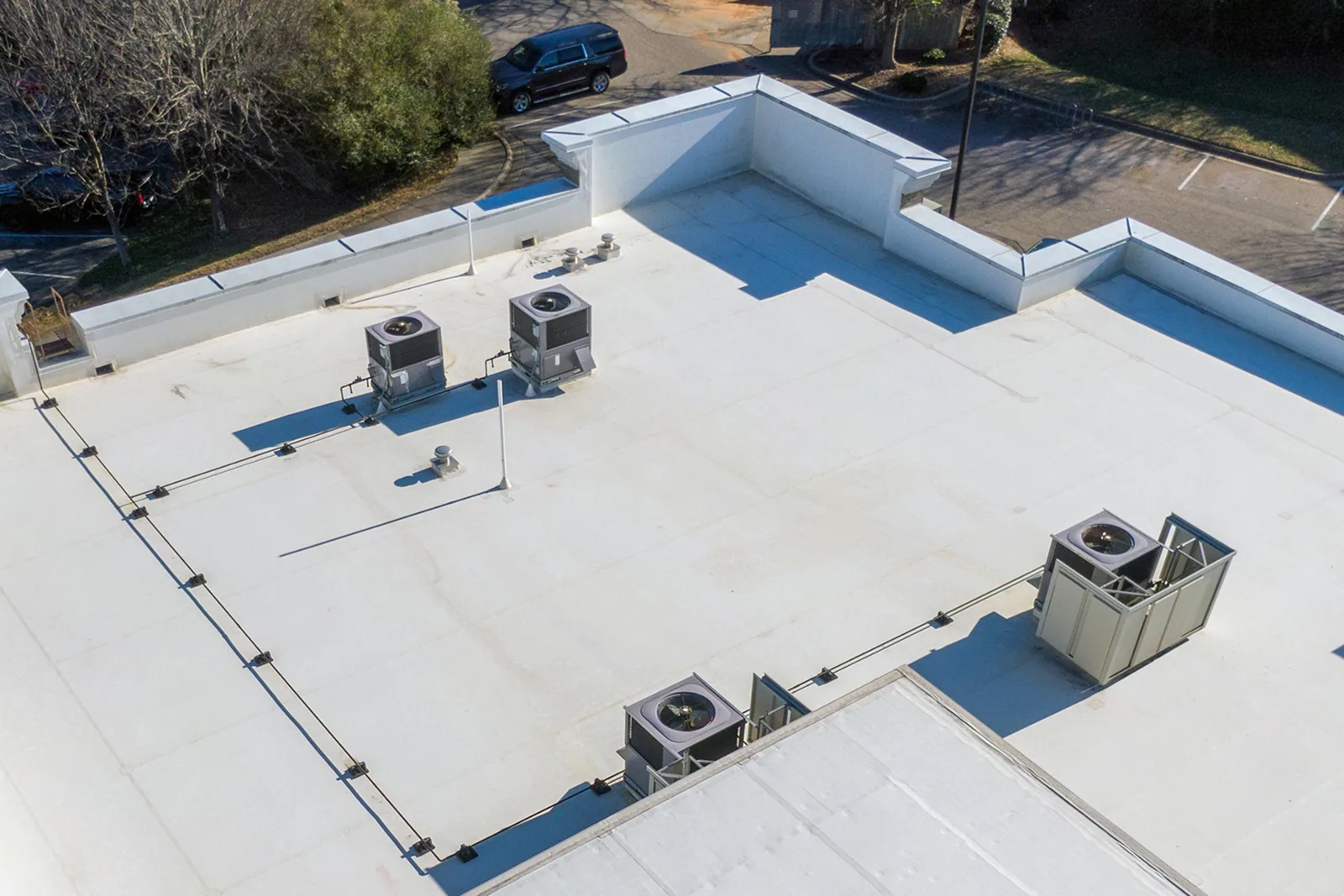
Penetrations are where a large share of commercial roof leaks begin, and a commercial roof leak repair often ends at one, because each one interrupts the membrane and relies on a flashing detail that moves, ages and breaks before the field does. Flashing work is detail work, and detail work decides whether a roof stays dry.
What Penetrates a Commercial Roof
The list is long. Skylights and light domes. Roof hatches and smoke vents. Plumbing vents and drain stacks. Gas lines and electrical conduit. Refrigerant lines and condensate drains. Exhaust fans and intake hoods. Antenna masts, signage supports and lightning protection. Rooftop unit curbs, which are the largest penetrations on most roofs.
- Skylight curbs, domes and glazing seals
- Pipe boots, pitch pans and sealant pockets
- Curb flashings and counterflashing at equipment
- Conduit and refrigerant line supports
- Hatches, vents and exhaust outlets
Every item on that list needs a flashing that matches the roof system, and every flashing needs inspection on a schedule, since sealants dry out, metal fatigues and movement works at the joint.
How Penetration Flashing Fails
Pitch pans are a common failure: a metal pan filled with pourable sealer that shrinks away from the pipe as it ages, leaving a gap that holds water. Pipe boots crack in the sun. Rubber sleeves split at the top. Sealant at a counterflashing dries and opens. A skylight dome crazes and leaks at the gasket. A curb flashing that was installed with too little height lets water splash over the top in heavy rain.
With a recorded high of 107 F, summer heat works these details a little every afternoon. Roofs that have been patched repeatedly at the same penetration show layers of mastic that hide the real problem. We remove the old material, inspect the substrate, rebuild the flashing to match the roof system and test the detail with water where the situation allows. A flashing failure repair that stops at the surface fails again in the next season.
Penetrations by Building Type
A school or college building carries skylights, a gym or cafeteria exhaust, and mechanical rooms, often added across decades. A hospital or medical office has dense mechanical equipment and strict rules for interior leaks. On a VA medical center campus of 25 major buildings, listed on the National Register, penetration work is planned one building at a time. A retail center along University Boulevard or McFarland Boulevard has restaurant exhaust, signage supports and rooftop units belonging to several tenants.
A manufacturing plant has process vents, stacks and conduit runs. A warehouse has fewer penetrations but many roof hatches and smoke vents, and each is a potential leak. The approach is the same on all of them: inventory every penetration on the roof plan, rate each flashing, and group repairs by roof section so the crew works efficiently and the asset manager sees the total. A school roof with skylights over a gym is the classic case.
Curbs, Water and Drainage
A large curb or an equipment platform acts as a dam on the roof. Water comes down the slope, meets the curb and has nowhere to go but around it. Without a cricket on the high side, water ponds behind the curb and tests the flashing at its lowest point. Rainfall near 53.5 inches a year means that test comes often.
We look for ponding behind curbs and add crickets or tapered insulation to move water around them. Where a curb is wide, we check that the downslope side drains and that its flashing is not buried in debris. A well-flashed curb with poor drainage will still leak, and a poorly flashed curb on a draining roof will leak sooner than it should. Both parts have to be right. Rooftop units are the largest penetrations on most roofs, and their curbs and supports need their own flashing detail.
Wind, Domes and Loose Equipment
Wind tests penetrations differently than it tests edges. A skylight dome can lift if its attachment is old. A hatch can open and slam. An exhaust cap can tear free and tumble across the membrane, cutting it. After a tornado like the 2011 EF4 or a straight-line blow like the May 2025 storm north of Northport, with gusts surveyed at 90 to 100 mph, loose caps and displaced domes are among the first things we look for.
We check dome frames, hatch latches, vent caps and the straps that hold conduit and pipe supports. Loose items are secured or replaced, and any membrane they cut is repaired. A skylight that has moved, even slightly, gets its gasket and curb flashing rebuilt, since a shifted frame leaks long after the storm has passed.
The Penetration Log
Every penetration gets a number on the roof plan, with a photo, a flashing type, a condition rating and a repair date. That log is the most useful record on the roof, since it shows which details have been repaired, which are failing and which have not been inspected. A tenant who adds a unit or a vent should have it entered in the log, and the roofer who sets the curb must record how it was flashed.
Owners near University Boulevard and across the county use this log to plan flashing work in phases, to answer lender questions and to show an adjuster what existed before a storm. A roof condition report includes the log, and the next owner receives it with the building.
Scope and Sequence
The work follows the roof plan: inventory, photograph, rate, group by section, price. For each flashing we remove the failed material, check the curb or pipe, prime and reflash with the roof system's compatible materials, add counterflashing where the detail requires it and seal the termination. Work is closed up each day, with temporary protection over any opening.
Skylights are handled by removing the old dome and gasket, repairing the curb, setting a new dome or a cover and flashing the curb to the roof. For occupied buildings, work above sensitive areas is staged to keep the interior dry, with plastic and drip protection where needed. After the repair, we walk the roof with the property manager and update the penetration log with new photos and dates.
Commercial Roofing Questions
Why does the same pipe keep leaking?
Because the flashing is patched, not rebuilt. Mastic over a failed boot hides the leak for a season and then lets go. We replace the boot or pan, tie it into the membrane, and photograph the detail so the next inspection can check it.
Can a skylight be removed instead of repaired?
Yes. The opening is framed, decked and roofed over to match the system. It removes a leak path but also removes daylight, which the owner weighs.
How do you flash around a new rooftop unit?
A curb is set, flashed with the roof system and capped with counterflashing. The roofer coordinates with the mechanical contractor so the curb is sealed before the unit is set.
What does a pitch pan repair involve?
We clean the pan, check the pipe, refill with compatible sealer and slope it to shed water. Where practical we replace the pan with a pipe boot or a flashing collar.
Are penetrations covered by the roof warranty?
Often yes, if installed to the manufacturer's details. Added penetrations may require notice. Confirm the terms with the warranty paperwork.