
Rooftop Equipment Curbs and Supports in Tuscaloosa, AL
On the roof of a Tuscaloosa strip center, a superintendent can usually tell the age of a rooftop unit by the curb under it. The original curb is flashed into the membrane and capped with sheet metal; the replacement unit added later sits on a mismatched frame with a bead of sealant where flashing should be; and the third tenant's condensing unit stands on wooden sleepers laid straight on the roof, with a refrigerant line draped across the field. Each of those is a roof detail someone treated as an equipment detail, and each is a leak waiting for the next heavy rain.
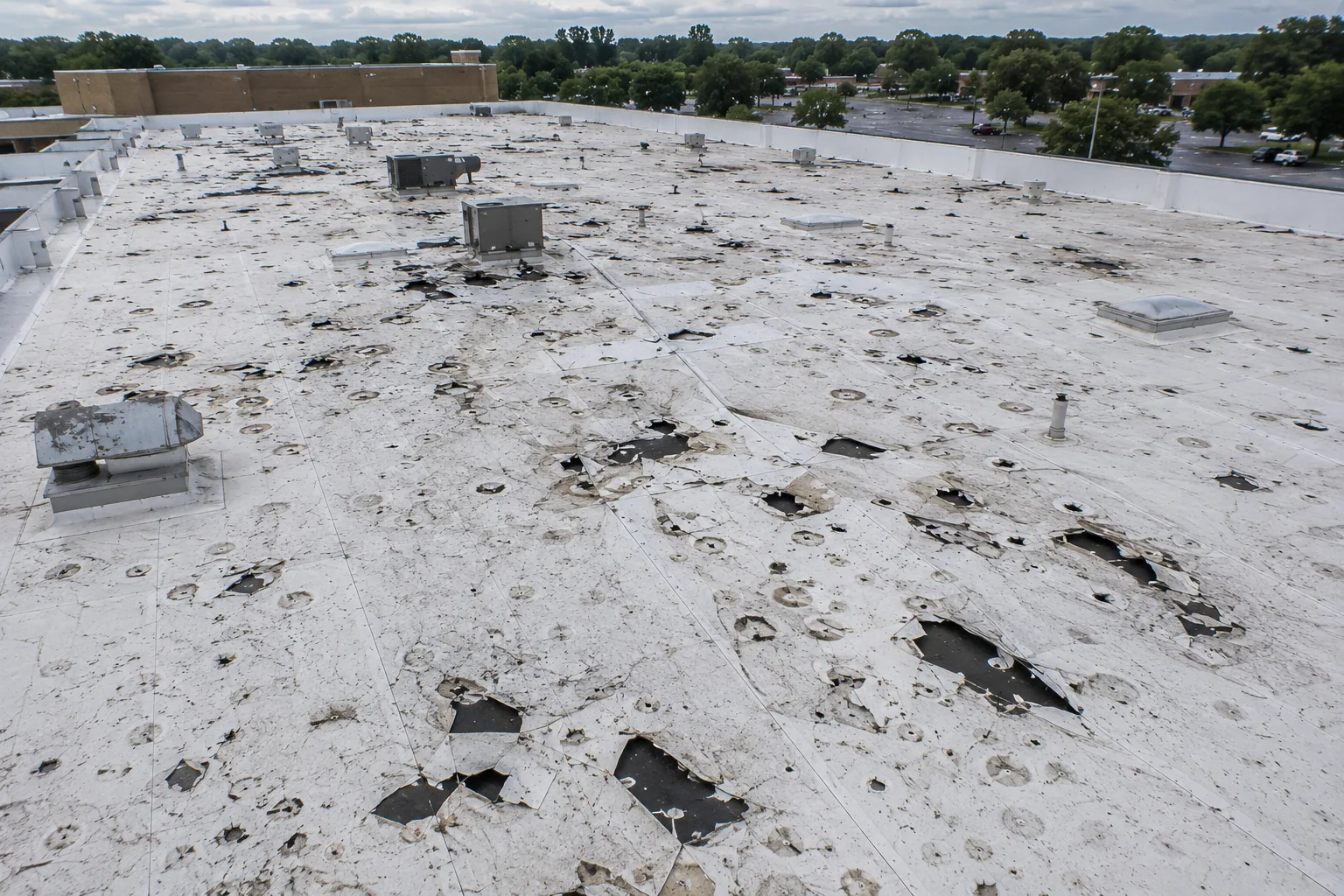
Equipment is the biggest load on most commercial roofs and the biggest source of repair calls. Curbs, rails and supports decide whether the units stay level, whether the membrane stays sealed, and whether the people who service them wear a path through the roof.
What Rooftop Equipment Needs From the Roof
A rooftop unit needs a level, rigid base that carries its weight to the structure, a sealed connection between the unit and the roof, and room to service it without damaging the membrane. A curb does this for larger units: a box that rises from the deck, is insulated and flashed, and receives the unit on top. Rails and sleepers do it for smaller equipment. Pipe and conduit supports carry lines across the roof without letting them rest on the membrane, and the small vents, hatches and stacks around them call for skylight and penetration flashing work of their own.
- Prefabricated or built-up curbs with insulation and cant strips
- Equipment rails and platforms on pads
- Pipe, conduit and refrigerant line supports
- Walk pads along service routes
- Counterflashing, storm collars and sealant pockets
When the curb is taller than the code or the manufacturer's flashing details require, water has to climb to get in. When it is short or uneven, water does not.
Common Curb and Support Failures
The common finding is flashing that was never integrated with the membrane. Units get replaced by mechanical contractors who set a new curb over an old one without roofing it. Counterflashing is left off, or it is a bead of sealant that cracks within a season. Wooden sleepers rot and let the frame sag. Pipe supports are set on the membrane without pads and wear a hole where the pipe moves. Condensate lines discharge on the roof surface and stain and soften it.
Tuscaloosa has a record high of 107 F, and heat makes metal and sealant move every afternoon. A curb that is not fastened properly shifts, and a flashing that moves with it opens. We find these by walking the whole roof and pushing on the equipment, not only looking at it. A flashing failure repair at a curb is often the quickest path to a dry building.
Equipment by Building Type
A retail center along McFarland Boulevard or University Boulevard typically carries rooftop units for each tenant, restaurant exhaust and makeup air, and a tangle of lines across the roof. A plant, including a supplier plant in Cedar Cove Technology Park, carries process exhaust, large fans and heavy units that need engineered supports. A hospital or medical office has dense mechanical systems and strict rules on interior leaks. A school has units added over years, on a mix of curbs and rails.
A distribution building has fewer units but they are often large, and the roof under them has seen heavy service traffic. Every building type needs the same inventory: each unit, its curb or support, its flashing, its clearances and its service path. A shopping center roof with a dozen tenants' units is the hardest to keep organized, and the inventory is what keeps it manageable.
Securing Equipment Against Wind
Equipment that is not tied down can move in strong wind, and a unit that moves tears flashing, cuts membrane and sometimes falls. No unit is expected to survive a direct tornado hit like the 2011 EF4, but the attachment of curbs and equipment to the structure is part of a wind-ready roof, and the May 2025 gusts of 90 to 100 mph north of Northport are a fair test of it.
We check hold-down bolts, restraint cables, curb fasteners and unit hold-downs against the manufacturer's installation data where it exists. Loose items are secured, and units that are not attached at all are flagged. After a storm, displaced equipment is the first thing a superintendent looks at, and the flashing around it is the second. Coordination with the mechanical contractor is part of the work, since structural attachment is their scope and sealing is ours.
Water Around Equipment
A curb is a dam. Water running down the roof meets its high side and stops, so a curb with no cricket behind it holds water against its own flashing. With roughly 53.5 inches of rain a year, that flashing is tested often. We look for ponding on the upslope side of every curb and add a cricket or tapered insulation where water stands.
Condensate is the other water source. A unit that drips onto the membrane every summer afternoon leaves a stain, then a soft spot, then a pinhole. We route condensate to a drain, a pad or a pan, and where a line crosses the roof we support it on a pad so it does not wear a groove. Cleaning algae and mineral buildup under the discharge is part of the repair.
The Equipment Inventory
Each unit gets a number on the roof plan, with its location, type, curb or support, flashing detail and last service date. Walk pads are marked along the service routes, and cable and pipe runs are recorded with their supports. The inventory shows who owns each unit in a multi-tenant building, which matters when a tenant leaves a unit behind or when a leak traces to a specific unit.
That record lets an asset manager require roofer coordination for any equipment change, and it supports a preventive roof maintenance schedule that checks the units at every visit. It also feeds plans for new work: before a replacement roof or a solar array, the equipment inventory shows what has to be lifted, relocated or left in place. Owners along McFarland Boulevard and elsewhere in the city use the same inventory format.
Scope and Sequence
Curb and support work is planned with the mechanical contractor. We inventory the units, mark the ones that need to be lifted, agree on shutdown windows with the building manager and set the order: shut down, disconnect, lift, repair the curb and flashing, set the unit, reconnect, restart. Units that cannot be shut down in hot weather are done in cooler hours or with temporary cooling.
Supports and walk pads are installed while the roof is open so they sit on protected membrane. After the work, the roof is flushed and photographed, the inventory is updated and a short report lists what was done to each unit. Occupied buildings get notice for noise and for any shutdown that affects tenants.
Commercial Roofing Questions
Who is responsible for flashing a new unit?
The roofer should flash the curb and the mechanical contractor sets the unit. We coordinate with both so the roof stays sealed.
Can a leaking curb be fixed without lifting the unit?
Sometimes. If the unit can be shut down briefly, it may be tilted or supported to allow flashing work. Many curbs must be reflashed with the unit lifted.
Do you install walk pads?
Yes. Pads along service routes protect the membrane from foot traffic and tools. We place them where the wear is, not just where the plan shows.
Why do condensate lines damage roofs?
Constant discharge stains and softens the surface, and algae grows. Lines should be routed to a drain or a splash pad on a protected surface.
How tall should a curb be?
Height is set by the membrane manufacturer's details and the designer. We confirm it on each project and match it when replacing a curb.