Hotel Roofing in Tuscaloosa, AL
Standing on a hotel, a superintendent finds a roof in pieces: a low-slope membrane over the lobby and meeting space, a steeper or flatter section over the guest wings, a mechanical penthouse and, on some buildings, a pool deck or terrace whose waterproofing is a roof of its own. Under each piece sits something with a nightly rate. Our crews repair, recover and replace hotel roofs in Tuscaloosa, AL, and our reports tie every roof section to the rooms beneath it, so a manager can see which leak costs a room-night and which only costs a ceiling tile.
Guest Wings, Lobby Roofs and Mechanical Penthouses
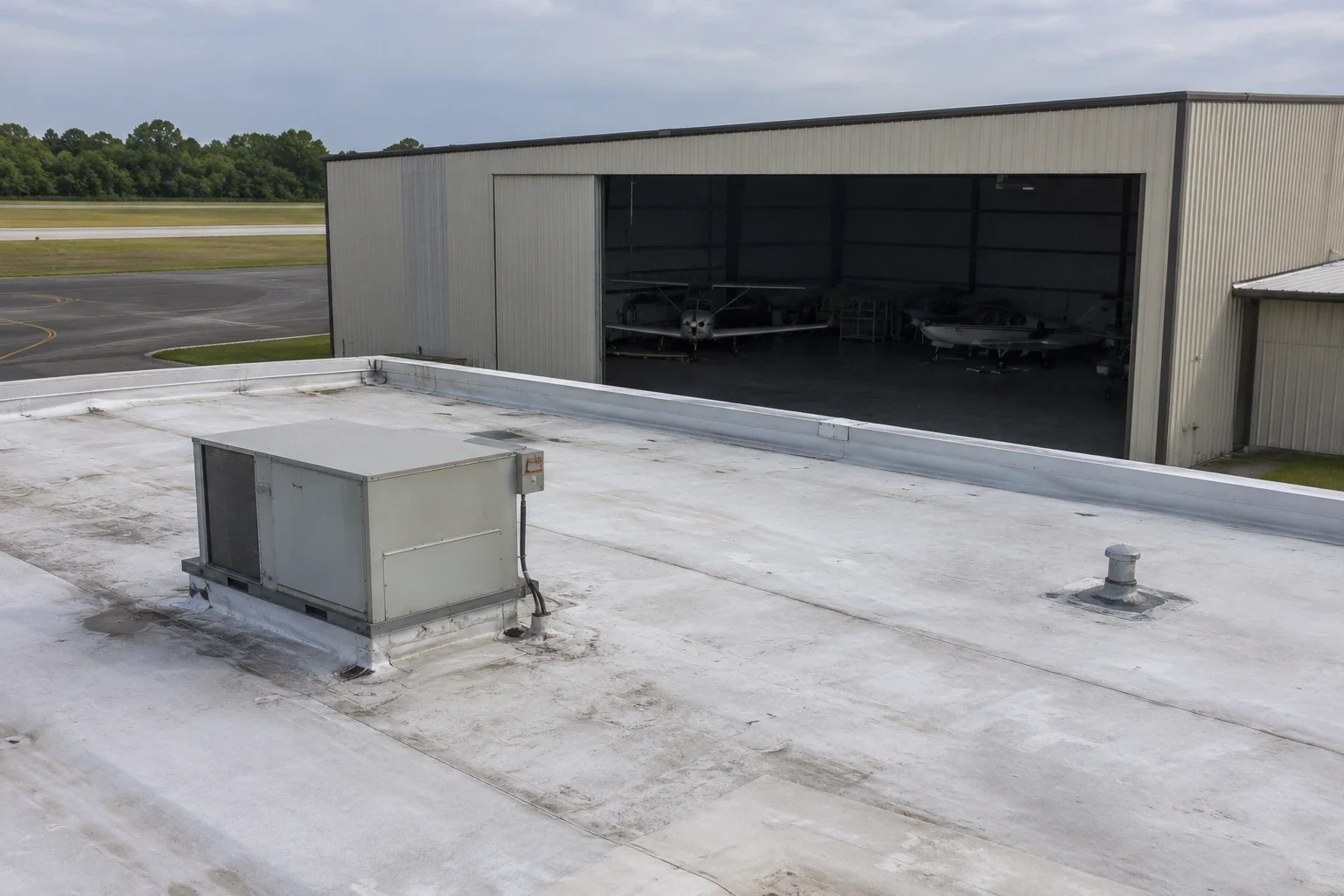
A hotel roof is divided by use. The guest wing roof is often a wide low-slope field with vent stacks for bathrooms and a few rooftop units; the lobby and meeting space may have a different height and system; a kitchen wing adds exhaust. Each junction between these roofs has flashing that moves as the buildings expand and settle, and those transitions are where hotel roofs leak most readily.
We map every section, its system, its age, its drains and the rooms below. Bathroom vent stacks and plumbing vents are numerous on guest wings, and each boot is a small flashing that ages in the sun. We count them, test a sample and recommend replacing them as a group when they share an age and a pattern of cracking.
Balconies, porte-cocheres and covered walkways form a third family of roofs. They are small, exposed and often drained to the outside, and guests walk beneath them. We rate their edges, gutters and fasteners alongside the main roofs, since a loose piece above an entrance is a safety matter and a repeated leak at a balcony joint stains the wall for years.
Stains, Odor and Room-Level Evidence
Hotels have a good source of evidence that other buildings lack: the housekeeping and maintenance log, which records which rooms had ceiling stains, odors or taken-out-of-service nights. We compare it with the roof plan and look for clusters under one valley, one penthouse wall or one run of vents. A cluster points to a single source more often than a scatter does.
On the roof, we probe seams, check flashing at the wall junctions, test drains and look for ponding. A moisture scan finds wet insulation before it reaches a guest room, and cores confirm it. Because a hotel cannot sell a damp room, early detection is worth more than usual, and an infrared moisture survey across the roof is an efficient first step.
Kitchen and laundry exhaust bring heat and moisture. Laundry exhaust carries lint, which clogs drains and builds up on the sheet, and kitchen exhaust adds grease. We inspect both discharge points, clear nearby drains and recommend containment or extensions where wear shows. A hotel with its own laundry has a more demanding roof than one that sends linens out.
We also look for the quiet signs of long-term wetting: algae streaks, soft insulation underfoot and rust at fastener plates. Each is recorded with a photograph and a section number, so the report can rank sections by urgency and the owner can see how many rooms each one protects.
Wind History and Rooftop Equipment
Winds of an estimated 190 mph came with the 2011 tornado, and 90 to 100 mph came in a straight line north of Northport in May 2025. On a hotel, roof edges, penthouse walls and rooftop signs take the first load. Signs and antennas fastened through the membrane need their flashings checked after any event.
We check edge metal, parapet caps, the fastening of rooftop units and the base of any sign, and we record a wind note per section. After a storm, we walk the roof and compare. If damage is found, an emergency roof repair visit seals the opening first, and the permanent repair follows with documented conditions.
Rooftop terraces and pool decks are special cases. Their surfaces include pavers, drains and planter edges over waterproofing, and a failure there leaks into rooms or meeting space beneath. We check the drains, the edges where the deck meets walls and any expansion joints, and we recommend a flood test when the cause of a leak is unclear.
Hospitality Along the River and the Campus
The Western Riverwalk follows the river edge of the downtown area from Oliver Lock and Dam toward the Mercedes-Benz Amphitheater, and Bryant-Denny Stadium holds an official 101,821. A hotel near venues like these least wants a roof crew above it on an event weekend, so the schedule looks for midweek, off-season windows.
The downtown Tuscaloosa and Tuscaloosa riverfront areas are service areas where each hospitality roof is surveyed on its own merits. A restaurant shares the kitchen exhaust, and an apartment complex shares the stack of occupied rooms.
Phasing Around Occupied Rooms
Hotel reroofing is phased by wing. The manager blocks rooms under the active section, we protect ceilings below openings and loud tear-off is limited to hours that guests tolerate. Staging stays away from the entrance and the porte-cochere, and deliveries and trash are coordinated with housekeeping.
Weather sets limits here, with highs that have reached 107 F and roughly 53.5 inches of annual rain, so a wing is opened early and closed before the afternoon storms arrive. Code requirements are confirmed with the building department ahead of pricing, and a punch list and warranty walk close the job.
The price turns on roof area, vent stack and penetration counts, wet insulation, deck condition and how many wings are phased. Each wing phased separately adds supervision and mobilization, and we price it as its own line so the owner can compare a wing-by-wing schedule with a shorter, more disruptive one.
What to Carry on the Books
A hotel owner should carry each roof section with its rating, the number of rooms below, the equipment on it and a replacement window as a range. The roof capital planning list ties roof work to the brand's renovation cycle, since a property improvement plan often forces a roof decision on a date the owner did not choose.
The record should state the brand's roof requirements, warranty terms and approved contractors where they apply. Written beside the findings, those notes let an owner answer a franchisor's inspection with documents instead of a new survey.
Lenders and franchisors also read the file. A dated survey with photographs shows the roof's condition at a point in time, and a log of repairs shows a pattern of care. Both answer questions asked during refinancing, a sale or a brand review.
Pool equipment, laundry exhaust and kitchen hoods each have an owner on the property staff, and the report names that person beside each item, so a roof finding reaches the right desk instead of the general manager's inbox.
Commercial Roofing Questions
How do you tie a leak to a guest room?
By comparing the maintenance log with the roof plan. Clusters of affected rooms point to a source on the roof.
Can a hotel stay open during reroofing?
Yes. The roof is phased by wing, rooms below are blocked and noisy work is limited to agreed hours.
Why are vent stack boots a concern?
Guest wings have many of them, they age together and they crack in the sun. Replacing the group costs less than repeated repairs.
Which dates should roof work avoid?
Event weekends and peak stays. The scope version lists blackout dates.
What about a rooftop pool or terrace?
It has its own waterproofing. We rate it as a separate section with its own record.