
Heat and UV Roof Damage Repair in Tuscaloosa, AL
On a light-colored single-ply roof over a retail center, the superintendent who kneels down in July finds the damage in the surface itself: a membrane that has gone chalky under the hand, a seam edge that has curled a little at the corner, and a bead of sealant at a pipe boot that has cracked along its length. In Tuscaloosa, AL a humid subtropical climate runs from a record high of 107 F to a record low of minus 1 F with about 53.5 inches of precipitation between, so a roof here is wetted, baked and cooled again many times over its life. Heat and ultraviolet light rarely cause a leak on a particular afternoon. They wear the roof down until a rainstorm finds the weak spot.
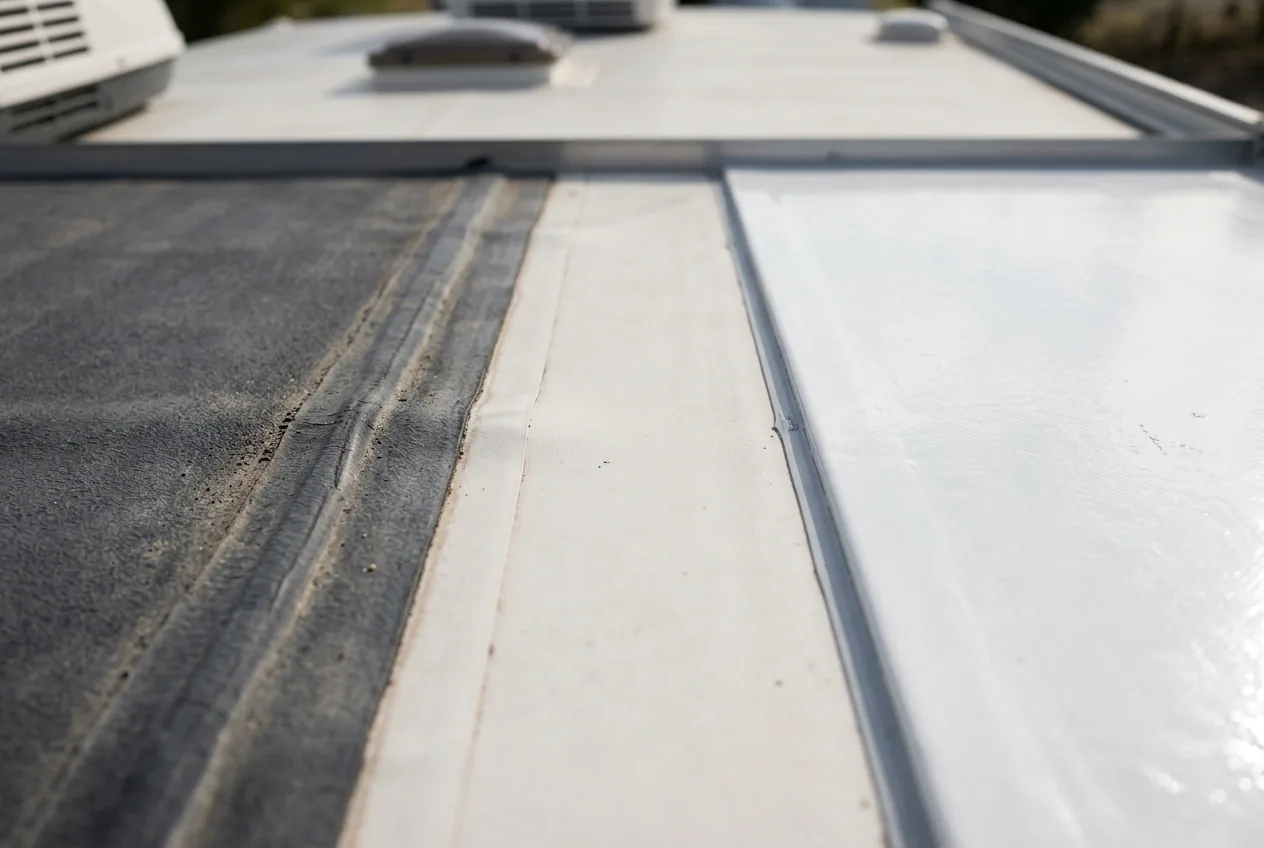
Repair starts with reading how far that wear has gone, and then deciding whether the roof can be restored or whether the section is nearly spent.
What Sun Does to the Membrane Surface
Ultraviolet light attacks the top few thousandths of an inch of a membrane first. On thermoplastic sheets it can strip the protective layer and expose the reinforcement scrim, which shows as a pale, rough, sometimes fibrous surface. On modified bitumen the granules wear away and the asphalt beneath hardens and crazes. On EPDM the surface dulls and may show fine cracks along folds and corners.
We feel for chalking with a gloved hand, check the color change, and compare a sunlit area with a shaded area under a unit or parapet, because the contrast shows how much material has been lost. A core cut at one or two locations lets us measure what remains. A membrane that has lost a small share of its thickness can be coated or maintained. One that has lost most of it is a replacement candidate, and the report says which case applies to each roof section.
Dark patches on a light roof deserve attention too. Dirt, algae and mildew hold moisture against the surface in a humid climate and can speed wear in the spots where they collect, usually near drains and along the shaded side of parapets. We clean a test area to see whether the stain is only on top or whether the membrane beneath has changed, and the photograph before and after goes into the file.
Thermal Movement at Seams and Curbs
A roof expands in the afternoon and contracts overnight, and the movement is greatest at places that are fixed in position: the base of a rooftop unit curb, a pipe penetration, a parapet wall. Repeated cycling stretches sealants, pulls seams at their ends and fatigues flashing metal. Over a few hundred cycles a year, that adds up. Heat damage often shows up first in exactly those places, and the repairs follow the same steps as seam failure repair and flashing failure repair: clean the surface, remove the failed material, rebuild the joint and record it.
We probe seams for open edges, check the flashing at every rooftop unit curb, and mark any sealant that has cracked, pulled away or hardened. A hairline crack at a curb corner takes a few minutes to repair when found in the dry season, and a long, expensive investigation when found as a ceiling stain.
Retail, Industrial and Institutional Roofs
On a retail roof, such as those around Shoppes at Legacy Park, University Mall and Midtown Village, each rooftop unit, vent and service route adds heat load, foot traffic or a penetration to inspect. Along McFarland Boulevard, we check the walkways between units for membrane wear and recommend walk pads where the surface is already thin.
Industrial and supplier buildings in Cedar Cove Technology Park and the Airport Industrial Park are where we compare roof sections side by side, since a plant and a distribution building may differ in surface condition even when they sit a short distance apart. A hospital or university building has its own difficulty, because rooftop equipment runs all day and the access routes have to stay clear of interior activity. For each type, the first walk looks at the surface, the seams, the curbs and the drains, in that order.
Coating, Recoat or Replace
When the membrane is sound but weathered, a roof coating restoration can add service life and reduce surface temperature. The roof is cleaned, defects are repaired, seams and flashings are reinforced, and a liquid-applied coating is rolled or sprayed over the surface. A silicone coating handles ponded water well, while an acrylic coating suits roofs that drain freely. The choice depends on the existing membrane, the drainage and the budget.
Coating is not a rescue for a roof with wet insulation, open seams across a wide area or a brittle membrane that cracks when flexed. We test for moisture first, and if the insulation is wet, restoration waits until the wet material is replaced. When the surface is too far gone, replacement is the better value, and the written scope shows both numbers side by side.
Reflective Surfaces and Energy Code
A reflective surface lowers the temperature of the roof and the load on the cooling equipment beneath it. A cool roof installation uses a white or light membrane, or a reflective coating, to reduce the heat the roof absorbs. A cooler surface also moves less, which slows some of the aging.
Energy rules are a separate matter: Alabama names ASHRAE/IES 90.1-2013 as its commercial standard, and the licensing board for general contractors can adopt a code of its own after October 2024. We confirm the requirements that apply to each project before specifying insulation and reflectivity, and the scope states the values used. Where dirt buildup has reduced reflectivity, a wash and a fresh coating can recover some of the performance.
What to Carry on the Books
Heat and UV damage is gradual, so the record matters more than the repair. We photograph the surface condition in each roof section, log the core-cut thickness, note the sealant condition at each curb and rate each section against a simple scale. A year later, the comparison shows how fast the surface is wearing.
With that record, an asset manager can plan. A section with a few good years left goes on a preventive maintenance schedule with inspection before and after summer. A section near the end of its service life goes onto the capital line with a replacement date. Either way, the cost is known in advance and the leak does not set the schedule.
Commercial Roofing Questions
How do I know if UV has damaged my membrane?
Look for chalky residue on your hand, color fading, exposed reinforcement and fine cracking at folds. A core cut measures the remaining thickness and gives a firm answer.
Can a coating fix a heat-damaged roof?
Where the membrane is sound and the insulation dry, a coating can add service life. Wet insulation or a brittle membrane will not hold one.
Why do seams open in summer?
The roof moves with temperature, and a seam that was marginal at installation takes the stress first. Probing the laps shows which ones are opening.
Do walk pads help?
Yes, on routes between rooftop units. A heat-softened membrane scuffs easily under repeated foot traffic, and a pad takes that wear.
Does a white roof last longer?
A cooler surface slows thermal aging, though it also depends on the membrane, the installation and the maintenance. We state the expected condition of each section in the written scope.
How often should surface condition be recorded?
Once before summer and once after, with photographs from the same positions. The comparison shows the rate of wear.