Roofing for Hotel Owners and Hospitality Groups in Tuscaloosa, AL
A hotel carries its roof differently from any other building because the people under it are paying for a night's sleep. A superintendent on a hospitality roof reads the guest-room wing as a long, regular membrane with a row of vent stacks and a stair-tower penthouse at one end, the ballroom as a wide span with its own mechanical units, the porte-cochere as a low flat roof that guests walk beneath, and the pool deck and kitchen exhaust as the two places where moisture and grease do the most damage. Tuscaloosa, AL brings rain near 53.5 inches a year and a wind record that belongs in every owner's file, and water in a booked room costs revenue that same night.
Guest-room wings and quiet hours
Noise and dust on a guest-room roof turn into complaints within an hour. We plan the work around check-out and check-in, schedule the loudest tasks for the late morning and early afternoon when the building is emptiest and ask the general manager which rooms are booked, which are out of order and which hold the guests most likely to be disturbed. Rooms directly under the work zone are blocked when possible. If the property is full for a big weekend or an event, we move the work to the far wing or pause it, because a roof job should never be the reason a guest changes rooms at midnight. The crew uses a spotter at the entrance, keeps the lift off the guest drive and carries debris out through a service route, never the lobby.
Housekeeping gets a heads-up too, since a ceiling that is touched from above can shed dust onto linens, and rooms under the work zone are inspected by the foreman and a housekeeping lead before they are released. Each evening we sweep the roof and the ground, close every open section and give the manager a short note on what was opened, what was sealed and what the next day will bring.
Rooftop units, vent stacks and the penthouse
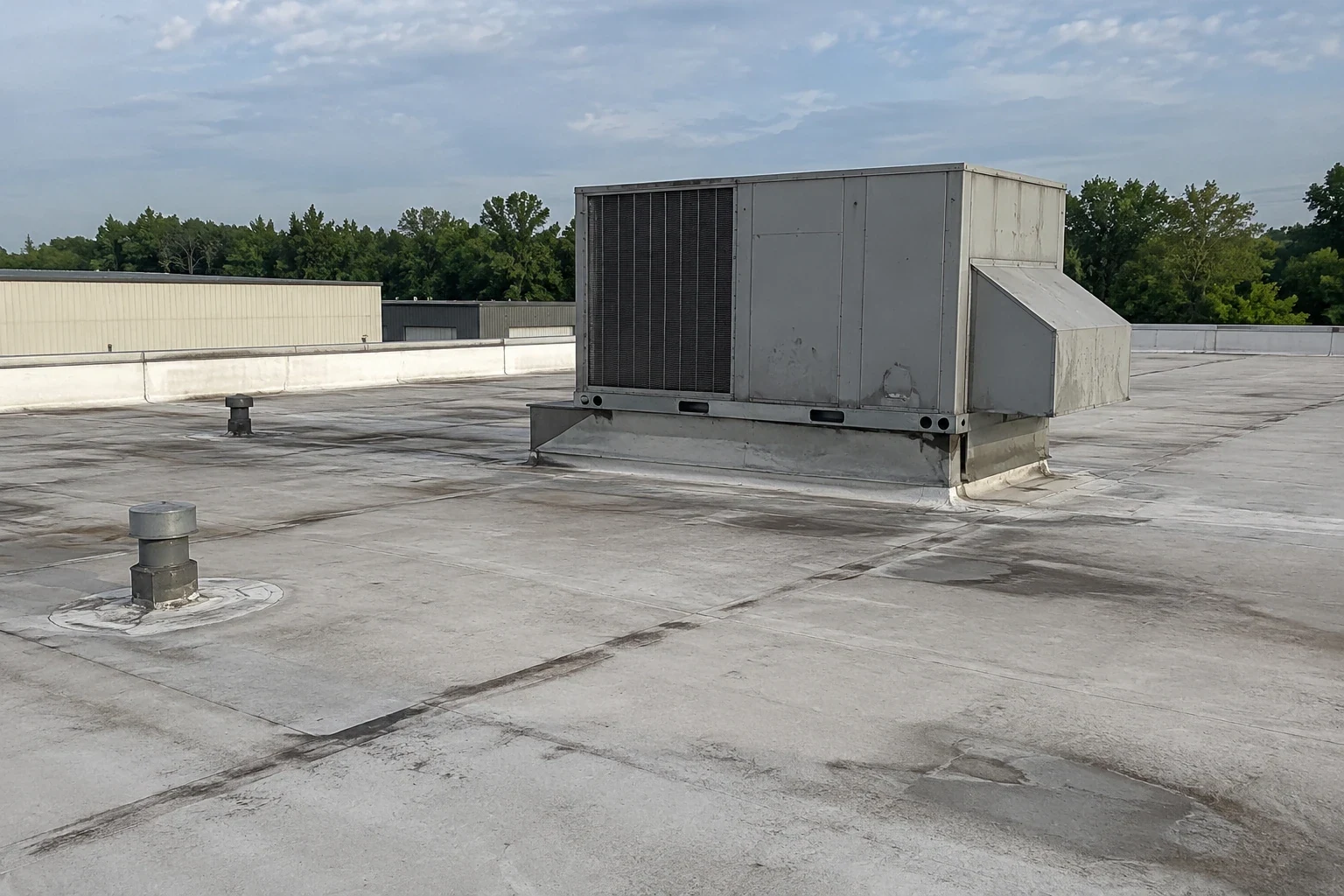
A hotel roof is crowded with mechanical equipment: packaged units, exhaust fans for bathrooms and laundry, plumbing vent stacks and the stair-tower or lift-machine penthouse. Each is a penetration, and each leaks when its flashing dries out or its curb was cut for a different unit. We map every item, check the curb height and flashing, look at the sealant and note any condensate line that dumps onto the membrane. Laundry exhaust adds lint and heat, so the sheet near it is checked for softening and the vent for blockage.
When units are replaced, the curb often needs a new flashing, and the roofer should see the plan before the mechanical contractor cuts the deck. The same goes for new exhaust risers, a pool heater flue or a satellite dish for the lobby bar: each is a hole that someone will flash, and it should be flashed with the roof in mind. We review the equipment drawings and coordinate the change so the new unit does not become the next leak.
Pool decks, kitchens and humid interiors
Where a hotel has an indoor pool, a spa or a commercial kitchen, the interior pushes vapor and heat up toward the roof. Without a proper vapor retarder, moisture condenses in the insulation and the roof fails from beneath. Where the insulation feels soft, a core cut shows the layers, the rust on the fasteners and any damp board. Kitchen exhaust adds grease, which attacks some membranes, so a chemical-resistant sheet such as PVC is a common choice near the discharge, with a grease tray and a cleaning routine to protect it. Pool equipment rooms and exhaust from chlorinated air also corrode metal, so the fasteners, the curb caps and the edge metal near them are checked for rust and replaced in stainless or coated hardware where the old pieces have failed.
Wind, canopies and guest safety
The EF4 that crossed 15th Street and McFarland Boulevard in April 2011 was estimated at 190 mph, and the survey of the May 2025 storm north of Northport found straight-line gusts of 90 to 100 mph. The porte-cochere or entrance canopy takes wind and shelters the people standing under it, so its attachment to the building, the fasteners on each panel and the gutter or scupper at its edge are all inspected. The main roof gets a wind-uplift rating, an edge metal check and a pull test where the attachment is unknown. A hotel that records those numbers can answer an insurer and a brand inspector the same afternoon. After any storm, the roof is walked for lifted edge metal, displaced coping, torn flashing and clogged drains, and the findings are dated and tied to a roof section, so a claim or a repair order can be written the same day without anyone relying on memory.
Brand standards, inspections and capital cycles
Franchised hotels answer to property improvement plans, brand inspections and renovation cycles, and a roof that fails an inspection can hold up a renewal. Our roof condition report gives the owner a photographed account of each roof section, the age, the leaks on record and the cost to leave each alone, which can be shared with the brand and the lender. When an inspector flags a stained ceiling tile or a patched roof, the owner can answer with the date of the repair, the cause and the plan, instead of promising to look into it. A roof capital plan then places the replacements in the years the renovation budget can carry them, and the owner can pair them with other work to avoid disturbing guests twice. Owners who also run managed properties in other lines can see hotel roofs on the same ranking as the rest of the portfolio.
Repair, recover or replace without closing the hotel
The hotel stays open, and the roof plan has to say how. A staged reroofing goes wing by wing, with the rooms below blocked as the work moves. A dry roof with local failures is repaired, and a sound membrane may be restored with a coating. Wet insulation across much of the roof is replaced. For a group with more than one hotel, a multi-site program keeps every property on the same scale. Hospitality owners who also hold apartments or office space can use the same scope format across all of it.
What to carry on the books
The file for each property lists roof sections, system, age, equipment, wind-uplift rating, last core cut and punch list. The format holds for a property on McFarland Boulevard or the University Boulevard corridor, and investors who finance hotels can read the same report.
Commercial Roofing Questions
Can the hotel stay open during a reroof?
Yes. We work wing by wing, block the rooms below as the work moves and seal every section before the crew leaves.
How do you limit noise for guests?
By scheduling loud work for late morning and early afternoon, blocking rooms under the work zone and using a spotter at the entrance.
Why does a hotel roof need a vapor retarder?
Pools, laundries and kitchens push vapor toward the roof. Without a retarder, it condenses in the insulation and the roof fails from below.
What does the brand inspector want to see?
Condition by section, leak history, repairs made and a plan for the worst roofs. Our report covers each.
How are rooftop units handled during roof work?
The owner's technician shuts them down at agreed times, we log the hours and the curbs are reflashed before the units restart.