
Church and House of Worship Roofing in Tuscaloosa, AL
Most churches carry two or three roofs under one name: a steep shingle or metal roof over the sanctuary, a low-slope membrane over the fellowship hall and classroom wing, and a run of box gutters, valleys and flat canopies in between that nobody has looked at since the last storm. A superintendent climbing up there finds the sanctuary roof usually in better shape than the hidden flat sections, because the steep roof sheds water and the flat ones hold it. Tuscaloosa, AL adds about 53.5 inches of rain a year and a record of damaging wind, so the question for a building committee is not whether water will find the weak spot, but which spot it will find first.
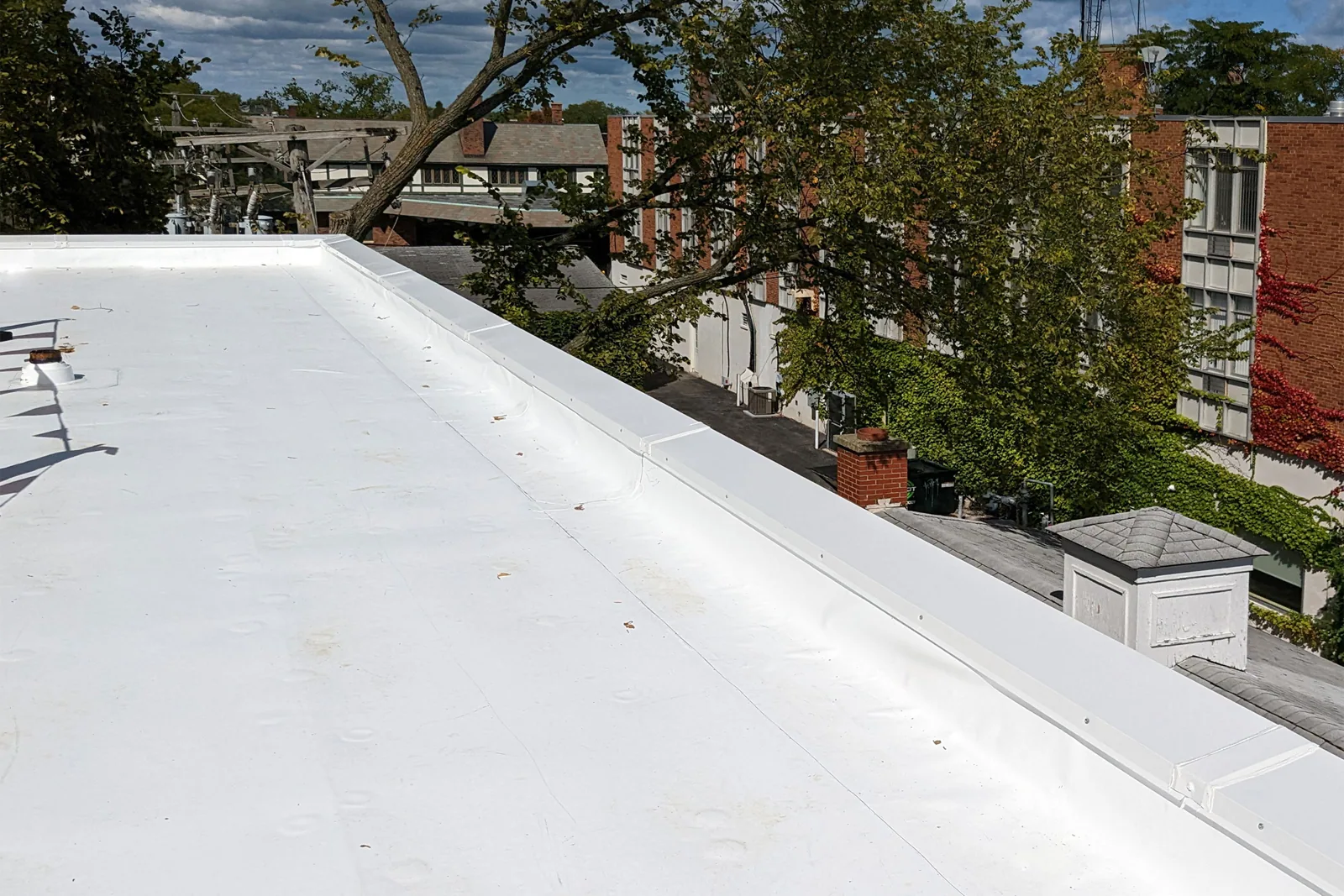
What a superintendent finds on a church roof
Churches grow by additions, and the roof tells that history. A sanctuary built in one decade gets a classroom wing in the next and a covered entry after that, and each joint where a new roof meets an old wall is a flashing detail that depends on a mason, a roofer and a carpenter agreeing years apart. We walk every one of those joints, probe the valleys, check the steeple or cupola base and look at the penetrations for the sound system, the heating and cooling units and the kitchen vent.
On steep roofs we look for lifted or slipped shingles, rusted fasteners, loose ridge caps and open nail heads. On low-slope sections we look for ponding, open seams, split flashing at parapets and cracked pitch pans. Stained glass and tall windows add another detail: the sill flashing and the sealant around the frame, where water can run behind a masonry face and show up as a stain on a wall twenty feet below the actual entry. Where a ceiling stain has appeared in a fellowship hall, we cut a core when the insulation feels wet, because that tells us whether a repair or a section replacement is the right scope.
Box gutters, valleys and hidden drainage
The drainage on a church is often built into the roof itself. A box gutter runs along a wall between a steep roof and a parapet, and when its liner fails or a leaf dam fills it, water backs under the shingles or over the edge and into the wall. Valleys between wings collect debris from nearby trees, and an interior drain through a flat roof can clog without anyone noticing until a stain shows in the narthex.
We clean and flush these paths first, then inspect the metal for pinholes, failed solder joints and loose terminations. A drain and scupper repair is usually a small fee against the damage that a clogged one causes to plaster, paneling and a congregation's carpet. We also look at where downspouts discharge, since a leader that dumps against a foundation wall or onto a walkway undercuts the same building the roof is meant to protect. Where a section has to be replaced, tapered insulation corrects the slope so that water has somewhere to go.
Services, funerals and the work calendar
A church building is empty some days and packed on others, and the roof schedule has to follow. We ask the office for the weekly calendar, including weddings, funerals, youth nights and holiday services, and plan noisy tear-off for the days the sanctuary is quiet. Lifts and scaffolds stay clear of the front doors and the parking that the congregation needs on Sunday, and every open section is dried in before the crew leaves.
A church that funds roof work through a campaign or a reserve needs a scope written in a form that the committee can present to members. We provide a ranked list with photographs, a clear line between what is urgent and what can wait, and a rough sequence that lets a church fund the worst section first and the rest in later seasons.
Wind, steeples and edge metal
Tuscaloosa's wind history is part of every church roof's file. The 2011 EF4 tornado, with estimated 190 mph winds, passed over 15th Street and McFarland Boulevard and left damage in Cedar Crest and Alberta City, and the weather service later surveyed 90 to 100 mph straight-line wind north of Northport in May 2025. A steeple, a tall gable and a long eave are exposed in a way that a low commercial box is not, so we check ridge caps, eave metal, drip edge and the fasteners behind them, and run a fastener pull test on older sections before deciding whether to re-secure or replace.
A congregation with a building in Alberta City, along McFarland Boulevard or out toward Northport should know the wind-uplift rating of each roof section and keep it on file.
Heat, attics and moisture in a high ceiling
A record high of 107 F shows what a summer afternoon can do to a roof deck and the air above a tall sanctuary ceiling. Trapped heat ages shingles from beneath, softens sealants and drives condensation when a cool air handler meets a hot attic. We check the attic space where we can reach it, look for daylight, wet decking and rusted nail points, and talk with the facilities volunteer about ventilation. Often a ridge vent or a baffle fix extends the life of a roof by years, and costs far less than replacing it early.
The same walk covers the roof-mounted equipment that churches add over time. Rooftop unit curbs, condenser pads, conduit runs and satellite or sound-system mounts each punch through the roof, and each needs penetration flashing that is sealed and sloped to shed water. We look at how the units are supported, whether the curbs are flashed up high enough, and whether a service technician has been walking across a membrane with no walk pad, since a path worn through the sheet is a leak waiting for the next rain.
Insurance, code and what the church keeps
After a storm, a church should document before it repairs. We take dated photographs of each roof section, note what is damaged and what is old wear, and prepare a record that supports an insurance claim when damage is real and states plainly when it is not. A replacement roof is permitted and detailed to the 2021 International Building Code that Alabama has adopted. The final punch list, the warranty and the core cut results belong with the building file, where a church's trustees can find them years later, as schools and public buildings do for the same weather.
Commercial Roofing Questions
How do we decide between repair and replacement?
By the moisture in the insulation and the condition of the deck. A dry roof with local failures gets repaired, while wet insulation across a section points to replacement.
Can work happen during the week without disturbing services?
Yes. Tear-off and noisy tasks are scheduled for quiet days, and each section is sealed before the crew leaves.
Why does a flat roof over a fellowship hall leak more than the sanctuary?
Flat roofs hold water at seams, drains and flashing, and the sanctuary's steep roof sheds it. The weak points are usually the joints between them.
What does a ranked list of roof sections look like?
A page per section with photographs, condition, cost to leave alone and the suggested year to act. The committee uses it to set a multi-year plan.
Does a steeple need separate attention?
It does. The base flashing, the fasteners and the roof around it are checked on their own, since wind loads concentrate there.