
Auto Dealership Roofing in Tuscaloosa, AL
On an auto dealership the superintendent finds at least three roofs before he reaches the first drain: a showroom with a low-slope membrane behind a tall parapet and a glass front, a service building with a run of bay doors and exhaust penetrations through the deck, and a canopy or porte-cochere that was added after the original construction and flashed to the wall by whoever was on site. A leak over a showroom floor means a new vehicle and a customer lobby are underneath it, and a leak over the service writer's desk or the parts room costs a shift. Tuscaloosa, AL pours about 53.5 inches of rain a year on those roofs, and the asset manager needs to know which of the three is failing before the next hard rain.
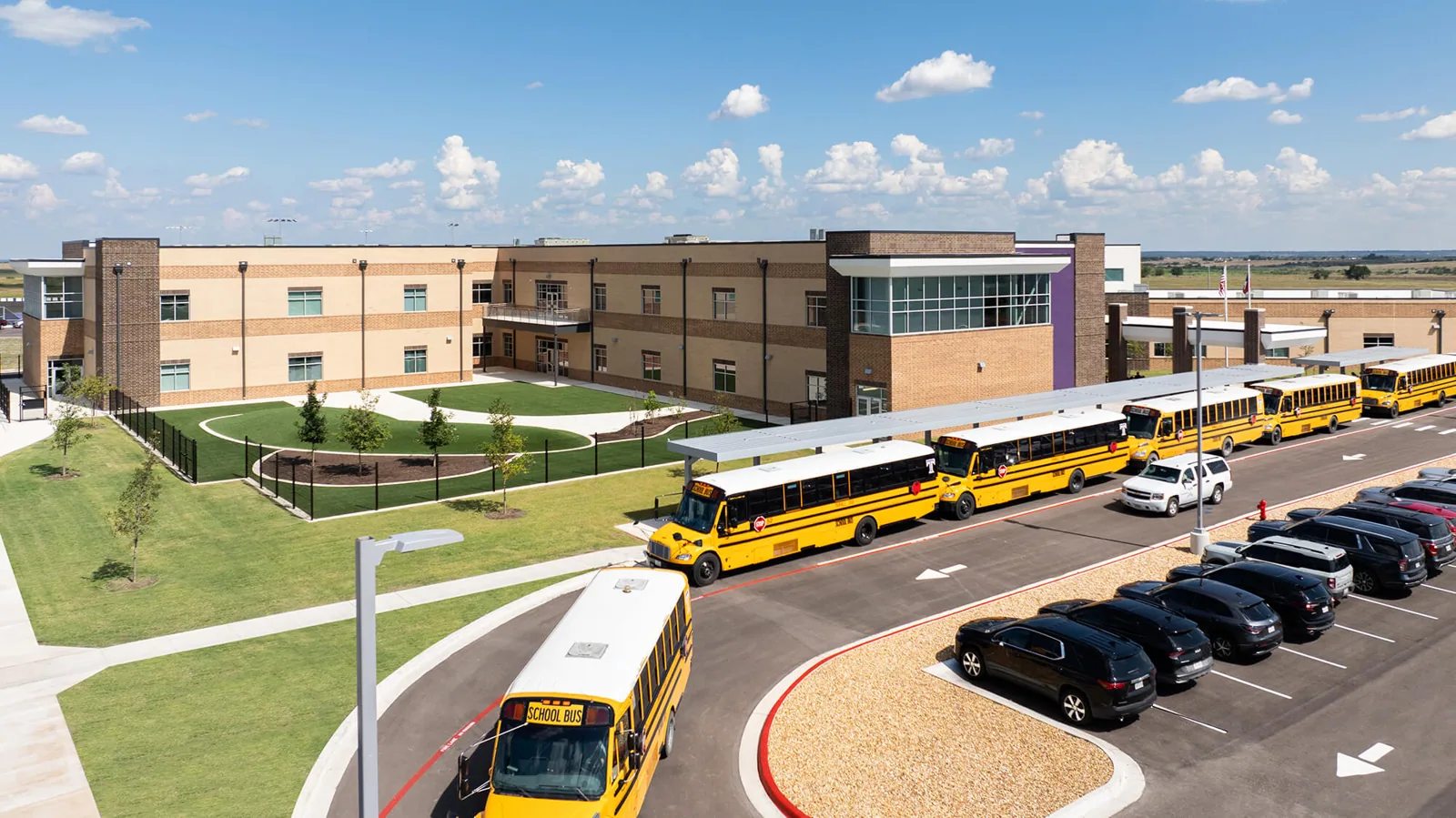
Showroom roofs and parapet walls
A showroom roof is usually a field of low-slope membrane surrounded by parapets, and the parapet is where the trouble begins. Coping that has lost its sealant lets water behind the wall, base flashing that has pulled away from the substrate lets it in beneath the membrane, and a glass storefront below the parapet shows the result as a brown stain on the soffit. We walk the full perimeter, press on the base flashing, look at the cap metal joints and probe the membrane seams near each corner.
Drains on a showroom roof often sit near the building's front or rear, and a clogged one can pond a foot of water against a wall that was not built to hold it. We check each drain sump, flush the lines and measure how deep water stands after a rain. Where the roof has ponding that does not drain within two days, tapered insulation corrects the slope during a replacement, which keeps the same problem from returning. If the showroom roof carries a glass curtain wall or a tall storefront below the parapet, we also look at the head flashing above the glass and the sealant joint where the roof edge meets the frame, since water that gets behind the aluminum shows up as a streak on the interior ceiling tile near the window, far from the actual entry.
Service bays, exhaust and rooftop equipment
The service building brings a different set of failures. Bay doors need headers that are flashed and sealed, exhaust fans and vehicle exhaust penetrations need curbs with a proper cap and storm collar, and the make-up air units that heat and cool the shop need curbs that are flashed high enough to stay dry. Oil mist, brake dust and fumes also settle on the roof around exhaust points, and they attack some membrane types faster than others. A white TPO or PVC surface stays easier to inspect than a darker, stained one, and a chemical-resistant sheet like PVC stands up better near grease and oil.
We cut a core when the insulation near a fan feels spongy, and map the wet area before pricing the repair, with a moisture meter or an infrared scan on a dry evening, because moisture that has traveled beneath the membrane from a bad curb can run twenty feet before it shows inside.
Canopies, drive-through bays and the roof you forgot
The canopy over the delivery lane or the customer drop-off is the roof nobody puts on the capital plan. It is often a metal roof on a light frame, flashed to the main building where two different crews met, and it collects leaves, drips onto cars and sheds water onto the very place a customer steps out. We check the connection to the wall, the fasteners on every panel and the gutter or scupper at the edge. A canopy that is cheap to fix this season can pull away from a wall in a storm and damage inventory below it, so we flag any loose attachment on the report. The gutter or scupper at the canopy edge gets cleaned, the slope toward it is checked, and the downspout is traced to the ground, since a canopy that drains onto a customer walkway is a slip claim as much as a roofing defect.
Wind, debris and the inventory below
Dealership lots keep a great many vehicles close to the roof, which makes wind a financial problem as well as a roofing one. An EF4 tornado with estimated 190 mph winds crossed 15th Street and McFarland Boulevard on April 27, 2011, and a May 2025 survey north of Northport measured straight-line winds of 90 to 100 mph. Gravel, loose coping and torn flashing become debris in that kind of wind. Every section gets its wind-uplift rating recorded, its edge metal and fasteners examined and, where the attachment is uncertain, a pull test, since a perimeter that holds keeps the roof on the building and the roofing pieces off the vehicles.
Keeping sales and service open
A dealership cannot afford a closed showroom or a dead service drive. We plan roof work around the sales floor and the shop, usually starting with the service building in the mornings, when technicians are in bays and the lift can stay clear of customer traffic. Showroom roof work goes in sections, dried in each afternoon, and we arrange the lift, the dumpster and the material staging in the corners of the lot that do not use up display space. Rooftop unit shutdowns are arranged with the manager and logged. For the lot itself, the crew covers or moves nothing without the owner's say, and we photograph the ground below before work begins. If a hot afternoon pushes the roof surface toward the 107 F air temperature Tuscaloosa has recorded, adhesives and welding schedules shift to the early hours, and the crew stops membrane work once the surface is too hot to handle safely. The sequence for reroofing an occupied building goes to the dealer in writing before the first section opens.
What to carry on the books
A dealer group with several stores needs a record for each building: the roof sections, the system and age, the core cut results, the last flashing and seam report, the warranty and the punch list. We rank the stores by risk and give each a number for what it costs to leave alone. Locations on McFarland Boulevard and Skyland Boulevard can share the same format, and neighboring shopping centers and big box stores give a useful comparison when a group wants to benchmark repair cost across retail roofs. For any store with an old built-up or modified bitumen showroom roof, the report also states how many layers are in place, because a second tear-off layer adds disposal weight and a recover decision depends on what is already there.
Commercial Roofing Questions
Which roof on a dealership leaks most often?
Usually the showroom parapet and the service building penetrations. Canopies are next, since they are attached to the main building after the fact.
Can work be done with the showroom open?
Yes. We work in sections and dry in each one before the day ends, with the lift kept outside customer routes.
What happens to cars if a roof is damaged?
We document the roof entry point and date, which supports an insurance claim, and we can tarp or patch the same day to stop further damage.
Does exhaust from the service bays harm the membrane?
Oil and chemical residue can soften some membranes. A chemical-resistant sheet or a walk pad and cleaning routine near the exhaust points protects the roof.
How should a dealer group rank its stores?
By moisture in the insulation, drainage condition and age of the worst section. We provide the ranking with photographs for each store.