
Commercial Roofing in Fosters, AL
For a small commercial building at a crossroads, the superintendent’s walk begins at the front edge and the loading side, since those are the places where trucks, ladders and weather all meet the roof. Fosters lies about 10.4 miles southwest of Tuscaloosa, and US 11 and US 43 run through the community, which makes it a place where small commercial roofs sit close to the traffic they serve.
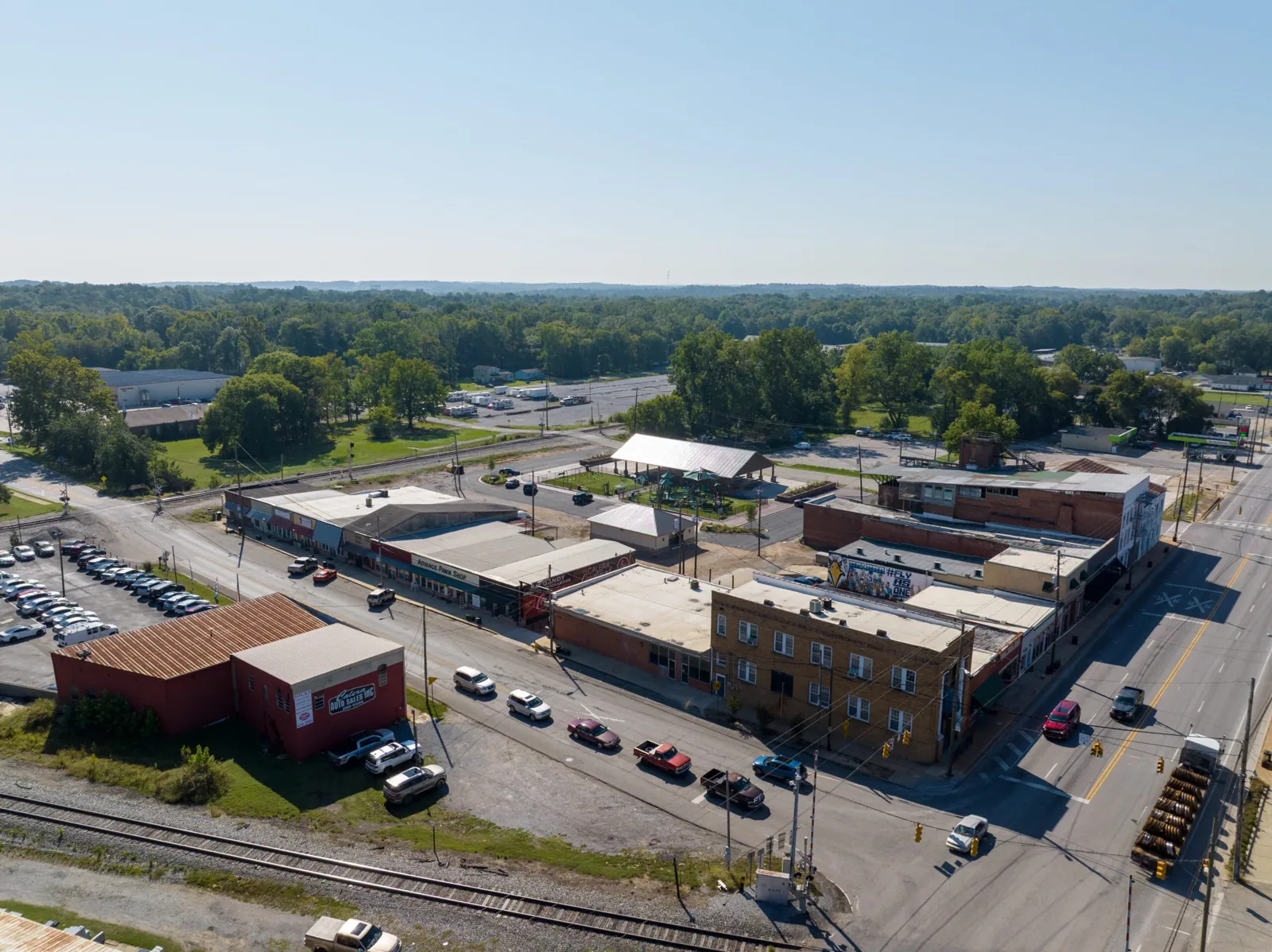
Local businesses such as Fosters Feed and Garden Supply and Fosters Foodland show the kind of building a roof walk should respect: small, with regular customers and no spare room for a roof that leaks over stock. Each roof is walked, identified and written up as found.
The walk is quiet and quick, and the report is short.
Small Commercial Roofs Done Properly
A small roof is easier to inspect and harder to fix cheaply, because every defect is a larger share of the whole. A cracked boot, an open seam or a loose panel matters more when there are only a few details to fail. We go through the roof section by section and list every detail, even the ones that look sound.
The walk covers the field, the edges, the penetrations and the drainage, in that order. For each section we write a photograph, a plan location, a score and a plain recommendation. A short report with those four items is more useful to an owner than a long one with none.
Many small buildings have more than one roof type on them: a metal front, a low-slope rear or a lean-to addition. Each gets its own section, and the transitions between them are probed, since a joint between two systems is the weak point of the whole roof.
A core cut tells us what is under the surface, and for a small building one or two cores are usually enough. The cores are photographed, patched and logged.
Rooftop equipment on a small building is usually modest: a single unit, an exhaust fan or two. Each still needs a curb check, because a unit set on a cracked curb leaks as surely as one on a large plant.
Skylights, vents and chimney-type penetrations are listed with the rest. A skylight with a failed seal or a vent with a cracked boot is a repair measured in hours, and the report prices it that way.
Metal Panels, Fasteners and Laps
On a metal roof, the fastener is the unit of failure. Exposed screws back out with heat cycling, washers crack and the hole around them opens. We count loose or missing fasteners by panel and photograph a sample, so the repair can be priced by count and not by guess.
Laps between panels and trim at ridges, eaves and walls are the other places to look. Sealant ages, and a bead that has cracked or pulled away lets water in. A metal roof retrofit can be an option when a roof is worn but the structure is sound, and the walk tells us whether that route is open.
Rust is photographed and rated when it appears. Surface rust on a panel is a maintenance item; rust through the panel or at the fasteners is a repair or replacement decision.
Gutters and downspouts get a walk as well. A sagging run or a split joint sends water against a wall, and the fix is usually inexpensive.
After a hard storm, panels near the eaves and ridge are the first to show movement. We check for lifted edges, creases and dents, and we mark any panel that no longer sits flat on its purlin.
Insulation under a metal roof can hide leaks, since water runs along the underside of the panel before it drips. Where a stain appears, we trace it upslope to the fastener or lap that let the water in.
Low-Slope Sections and Drainage
On a low-slope section, the drain is the heart of the roof. We clear each outlet, test it with water and measure standing depth the morning after rain. A pond that lasts a day points to a drain, slope or deck problem, and the repair follows the cause.
Seams on a membrane roof are probed with a seam probe, and each open lap is marked and photographed. Flashing at walls and curbs is checked for adhesion and sealant condition, and counterflashing is checked for looseness.
Insulation can be checked with a moisture scan. If the scan shows wet areas, a core cut confirms and the outline goes on the plan with a date. A commercial roof leak repair then targets the entry point.
Small low-slope sections often drain to a single scupper or a single drain, so one blockage means the whole roof ponds. We clear it, test it and photograph it, and we recommend an overflow if none exists.
Rain, Heat and Wind
The nearest weather record belongs to Tuscaloosa, roughly ten miles northeast: rain near 53.5 inches in a typical year and a record high of 107 degrees. Fosters roofs carry a similar load of rain and heat, with wind on top of it, from the April 2011 tornado at an estimated 190 mph to the severe straight-line winds of May 2025.
That is why edge details, fasteners and attachment are where a walk should start, and they get checked first.
After a storm, a quick return visit covers the corners and edges, then the field. A temporary seal goes on anything open, with photographs.
A roof near a highway collects road dust, pollen and debris, and drains fill. A quick clean-out in spring and fall keeps the load off the seams.
Heat cracks sealant and shrinks old membrane, and the first sign is usually a hairline crack at a curb or pipe. We catch it on the walk and list it with a price, and a small fix is done in the same visit when possible.
Keeping a Simple Record
Small owners do not need a thick binder. They need a one-page roof plan, a dated photo set and a short list of what to do this year, next year and later. That is what the report gives, and a preventive roof maintenance visit once or twice a year keeps it current.
Owners with other buildings in Samantha or Vance can use the same format, so the records line up.
An emergency roof repair call, when it comes, is answered at any hour, and the file tells the crew where the weak points already are.
The one-page plan and the photographs fit in an email, so the owner can forward them to an insurer or a lender without hunting for paper.
A phone photograph of a stain, with the date, is a useful start for a small-building owner, and it goes into the roof file along with whatever the walk finds.
Commercial Roofing Questions
How long does a roof walk take on a small building?
Usually part of a morning. The written report follows within days.
Can a loose-screw problem be fixed cheaply?
Yes, when caught early. Replacing screws and washers by count is a modest repair.
What if my building has two roof types?
Each gets its own section, and the joint between them is probed.
Is a metal retrofit possible?
Sometimes, if the structure and drainage allow it. The walk and the cores decide.
What do you need to begin?
Send the buildings you own, the most recent roof report and the person who can open the roof.