
Holcim Elevate Roofing Systems in Tuscaloosa, AL
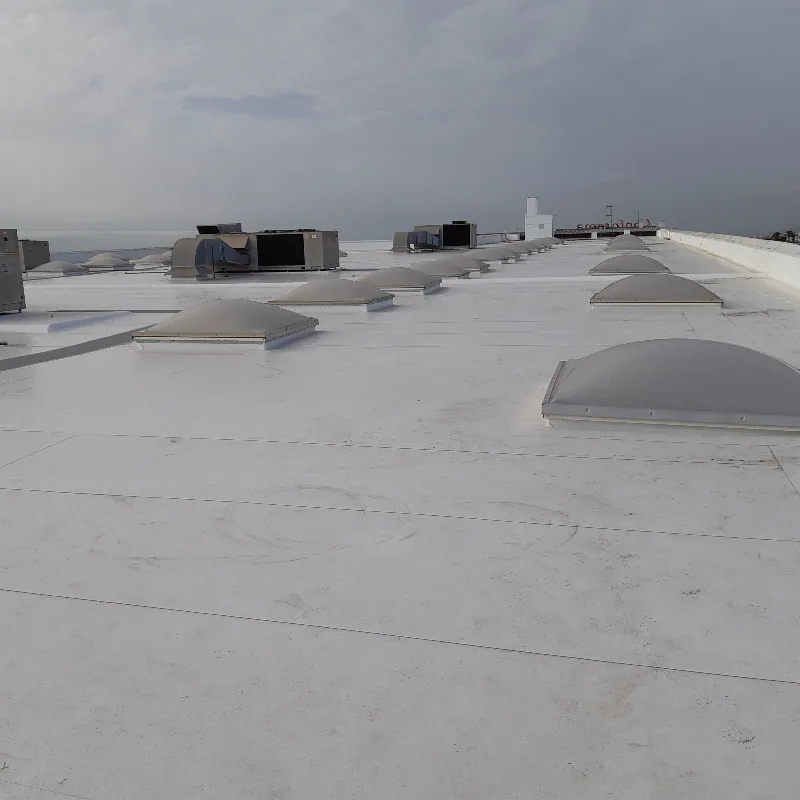
A long, flat plant roof in Cedar Cove Technology Park tells a superintendent a lot before anyone picks up a tool: the color of the sheet, the spacing of the fastener plates, the lines of the seams and the height of the curbs all point to the system underneath. Holcim Elevate is the name now used for the business formerly known as Firestone Building Products, and roofs installed under the earlier name are still in service across Tuscaloosa, AL. Whether the label reads old or new, the work starts the same way, by identifying the assembly and how it is held down.
Single-Ply Sheets, Insulation and Metal Edge
The manufacturer's commercial range includes single-ply membranes in more than one polymer family, polyiso insulation and metal edge and accessory products. That breadth means one building can carry several parts from the same source, with the membrane, boards, fasteners and edge metal all designed to work as a set. When a repair brings in a part from a different source, the compatibility of the new part with the old becomes the question to answer first.
We record, for each roof section, the sheet type, the thickness if it can be read from a sample, the attachment method and the edge metal profile. A rubber sheet is spliced with tape or adhesive, and a thermoplastic sheet is welded, so the toolkit for repairs differs. The record keeps that distinction in front of anyone planning work on the roof later. Edge metal gets the same treatment: the profile, the gauge where it can be read, the cleat or clip system and the sealant at each joint are noted, because a coping that was changed during an earlier repair can differ from the original and may not carry the same rating.
Plant Roofs and the Supplier Corridor
Inside the 950 acres of Cedar Cove Technology Park, off Progress Drive and Ed Stephens Road, the Mercedes supplier SMP Automotive Systems has planned a facility of 700,000 square feet. Mercedes-Benz U.S. International occupies 1,000 acres near Vance, and the county's large employers also include Michelin/BF Goodrich, Phifer and Nucor Tuscaloosa. Plants like these run on schedules that do not pause for a roof, which makes access routes and shutdown windows part of the scope.
On a plant roof the specifics add up quickly: process exhaust that can attack some membranes, rooftop units on curbs that have been reused through several replacements, and long runs of pipe on supports that bear on the sheet. Our Cedar Cove Technology Park work starts with those penetrations, since each is a place where the membrane is interrupted.
The same walk looks for the quieter faults that long roofs collect: a drain sump that sits proud of the deck, a scupper with a lip that holds an inch of water, a roof hatch curb with a cracked corner. None of these looks serious from the lot. Together they decide whether a section drains in an hour or holds a pond into the next day, and ponding is what tests every seam on the roof.
Heat Movement and the Cold Snap
The extremes in this city run from 107 F down to -1 F, and a dark single-ply sheet on a summer afternoon can run far hotter than the air above it. The sheet expands and contracts with that swing, and the movement concentrates at laps, corners and curb bases. Thermoplastic seams that were welded on a cool morning can be stressed differently from those welded in midday heat, so we note the install conditions when they are known.
Cold weather matters mostly for materials. Adhesives, sealants and tape have minimum application temperatures, and a splice made below its limit can look sound and fail the next season. The plan lists which work waits for a suitable day and which can proceed.
Wet-weather rules are written the same way. A section is opened only if the sheet can be dried in the same day, with temporary tie-ins at the open edge when a storm line is forecast. Precipitation of roughly 53.5 inches a year makes a clear morning a working window, so the crew keeps the day's scope sized to what it can close.
Perimeter Attachment After the 2011 Tornado
For wind, the references are the EF4 that wrecked 35th Street warehouses on April 27, 2011 and a straight-line storm in May 2025, 90 to 100 mph, whose damage fell above Northport. Those events are not design values for any one roof, but they explain why Tuscaloosa asset managers ask about perimeter attachment. The corner and edge zones of a roof see the highest uplift, and the fastening there is denser for that reason.
We check the perimeter on the first walk. Plates and fasteners are inspected for rust and lift, edge metal is checked for loose laps and missing sealant, and a pull test is run where the attachment is in question. A tornado damage roof repair follows the same checks in a storm's aftermath, with the weakest edge secured before anything else.
Repair, Restore or Replace, With the Code in View
Repair is the right answer when the membrane is sound and the failures are local. Restoration, a coating or a recover, is the answer when the field is aging but dry. Replacement is the answer when insulation is saturated or the sheet is failing across a section. The permit office decides which edition of the state's 2021 International Building Code applies to a given submittal, as the code took effect July 1, 2022 with exceptions.
The cost range for each path is written by roof section, so an asset manager can choose where to spend this year. A cured rubber EPDM sheet and a welded TPO sheet are repaired by different methods, and ranges such as Carlisle SynTec and Versico carry their own details.
Warranty Paperwork Under Two Names
Because the company name changed, older warranty paperwork may carry the earlier name, and the terms in it still govern the roof. We read those terms before work starts, check notice and repair requirements, and keep a copy of the document with the roof file under roof warranty management. A repair done by the book protects coverage that the owner has paid for, and a note in the record shows which sections are still under it.
Sequence on a Working Plant
On a plant roof the sequence is agreed before the first day. The superintendent meets the facility contact to fix the access route, the lift location, the hours when noisy work is allowed and any equipment that must be shut down. Each roof section is then opened, repaired or replaced and closed in turn, with curbs and penetrations finished as part of their section.
At the end the asset manager and superintendent walk the punch list, and the file picks up materials, locations and dates. A commercial roof repair between larger projects follows the same sequence on a smaller scale, so the file stays consistent over time.
Commercial Roofing Questions
Is Holcim Elevate the same as Firestone Building Products?
It is the current name of the business formerly known as Firestone Building Products. Older roofs and paperwork may carry the earlier name.
Can you repair an older roof from the earlier name?
Yes. We identify the sheet and attachment and repair it to the published methods for that system.
What does plant exhaust do to a membrane?
Some exhaust carries oils or chemicals that attack certain sheets. We note the sources and choose repair materials accordingly.
How cold is too cold for a repair?
It depends on the adhesive or sealant. Each product has a minimum, and the plan lists the work that waits.
What goes in the roof file after a repair?
Photographs, materials used, locations marked on the drawing and the date of the next walk.